
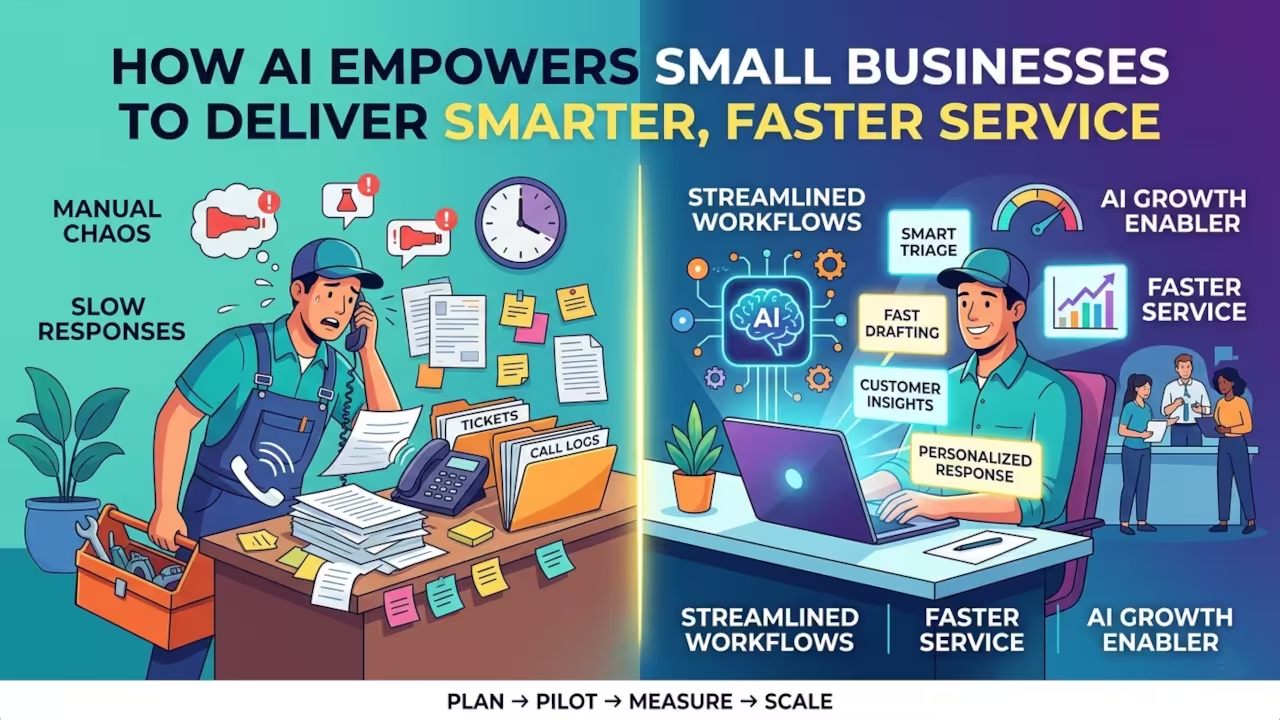
For local service business owners and lean ops teams, the daily grind isn’t a single bottleneck, it’s a chain of manual operational tasks and service delivery inefficiencies that compound across every ticket, call, and follow-up. When work lives in inboxes and tribal knowledge, customer experience limitations show up as slower responses, inconsistent answers, and missed handoffs that customers remember.
The core tension is clear: staying personal and high-touch requires time, but competitors scale speed and precision with automation. Many teams remain stuck because of business automation barriers, privacy worries, hardware constraints, and setup complexity, making modernization feel riskier than the status quo.
Key Takeaways at a Glance
- Use AI to automate routine support tasks and speed up responses with fewer manual handoffs.
- Use AI to personalize customer interactions and improve customer experience across service touchpoints.
- Use AI to reduce operational costs by streamlining workflows and minimizing repetitive work.
- Use AI to extract data-driven insights that guide faster, better business decisions.
- Use AI to boost team productivity by freeing staff for higher-value problem solving.
Generate Customer-Ready Content in Minutes, Not Meetings
Once AI has removed some of the obvious busywork, the next speedup is turning customer communication from a bottleneck into an on-demand output. Generative AI tools let small business owners instantly draft customer emails, spin up marketing copy, and generate FAQ-style responses, so a lean team can produce the volume and variety of a much larger workforce without adding headcount.
Under the hood, recent advances in neural networks and large language models (LLMs) trained on vast datasets have pushed quality forward: instead of templated, brittle text, these systems learn statistical patterns in language (and increasingly other modalities) and can synthesize realistic new content that reads like something a person would write. The same pattern-recognition capability extends beyond text to images and other creative assets, enabling lightweight customer-ready materials that used to require multiple roles or external help. If you want a practical orientation on what these systems can generate and why, use Adobe Firefly’s take on generative AI as a quick reference point. The key is tying each generative capability to the specific service bottleneck you’re trying to relieve, exactly what we’ll map out next.
Understanding Pain-Point-Driven AI Adoption
The core principle is mapping each AI-powered tool to a specific process pain point, then measuring the delta in time, cost, and customer outcomes. Because AI is a set of systems that adapts with new information, you can tune it toward your customers instead of forcing everyone through the same script.
For developers, this mindset prevents “automation theater” where you ship a bot and support quality drops. It also makes ROI legible: you can avoid staffing spikes when the cost per hire is high, while keeping human attention focused on edge cases and relationship moments.
Think of it like refactoring: you do not rewrite the whole codebase, you profile hotspots. Apply AI first to triage, summarization, and response drafting, then layer personalization from your knowledge base and ticket history. That sets up a staged integration roadmap with criteria, data controls, change management, upskilling, and guardrails.
Plan > Pilot > Protect > Train > Improve
To make this repeatable, use a lightweight service rhythm. This workflow turns “AI everywhere” into a controlled delivery loop developers can run like a sprint: isolate one service bottleneck, ship a narrow assist, and prove impact before expanding. It also keeps your open source stack and multimedia toolchain predictable by forcing decisions on data access, human review, and rollout mechanics, not just model quality.
| Stage | Action | Goal |
|---|---|---|
| Scope a bottleneck | Pick one queue, failure mode, and success metric | Clear target and baseline for comparison |
| Select and sandbox | Define criteria, test with real tickets, log outputs | Working prototype with traceable behavior |
| Add guardrails | Set data rules, redaction, approvals, and audit logs | Safer handling of sensitive customer data |
| Pilot with humans | Deploy to a small team, require review, capture overrides | Quality stays stable while speed improves |
| Upskill and document | Create playbooks, prompts, and escalation rules | Adoption sticks because behavior is taught |
| Measure and tune | Review deltas weekly and adjust prompts, routing, KB | Continuous gains without surprise regressions |
| Stage | Action | Goal |
Each pass tightens the feedback loop: measurement informs tuning, tuning shapes training, and guardrails keep iterations safe. Over time, your service system becomes easier to reason about because the AI is treated as a maintained component. Start with one queue you can measure this week.
Turning AI Into Reliable, Human-Centered Service at Scale
Small businesses feel the squeeze to respond faster and personalize more, without adding headcount or risking trust. The answer is treating AI as a strategic AI growth enabler, adopt deliberately, pilot and measure, then scale with ethical technology use and clear ownership.
Done well, competitive advantage through AI shows up as steadier service quality, tighter feedback loops for business innovation, and workforce transformation that makes teams more capable, not sidelined. Sustainable AI adoption is less about tools and more about disciplined, measurable responsibility. Pick one workflow to pilot this month, define success metrics, and review outcomes with the people who run it. That’s how AI becomes a durable source of resilience and long-term growth.
References
- TheEntrepreneurHub.com Michael Stephenson author of article
- Ojambo.com Edward Ojambo publisher of article
🚀 Recommended Resources
Disclosure: Some of the links above are referral links. I may earn a commission if you make a purchase at no extra cost to you.