
The VRAM Paradox
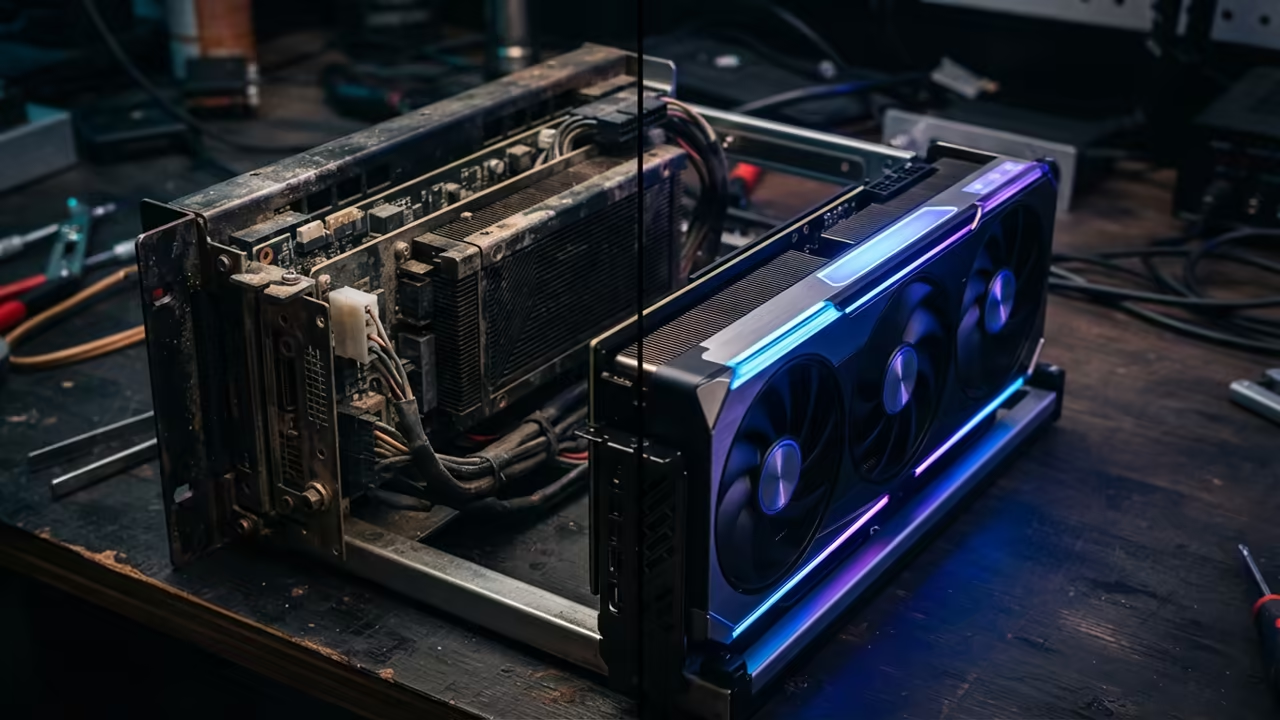
You are attempting to run a massive large language model on your new hardware. The error message appears instantly. You are out of memory. This is the modern technical wall. The modern 5060 is fast but its memory is small. The P40 provides the capacity that you need. Many enthusiasts believe that the newest card is always the best choice. This belief is a mistake for certain workloads. You might be leaving significant power on the table by ignoring legacy hardware.

I have spent years building specialized hardware stacks. The transition from consumer cards to enterprise hardware is difficult. I remember the first time I plugged in a used P40. It felt like a relic from a different era. Yet the capacity changed my entire workflow. My 5060 was incredibly fast for gaming. However it struggled with the large context windows required for complex reasoning. The P40 provided the headroom I needed.
Disclaimer: I may earn a commission from purchases made through these links at no extra cost to you.


The Technical Landscape
The technical landscape in 2026 is split between speed and capacity. The Nvidia P40 uses the Pascal architecture. It features 24GB of GDDR5 memory. This high capacity is vital for large model weights. The Nvidia 5060 uses the Blackwell architecture. It features 16GB of GDDR7 memory. The 5060 is much faster for most tasks. It includes DLSS 4 and advanced ray tracing. Yet it lacks the raw space of the P40.
| Feature | Description | Value |
|---|---|---|
| VRAM | Memory Capacity | 24GB GDDR5 |
| Architecture | Processing Architecture | Pascal |
| Performance | Relative Speed | Low |
| Power | Energy Consumption | High |
| Price | Market Cost | Very Low |
| Feature | Description | Value |
Insider Details and Configuration
When you use the P40 for inference you get stability. Large models fit into the memory without swapping. This prevents the massive slowdown of system memory usage. The 5060 is a powerhouse for rendering and gaming. It excels at real time frame generation. But the 5060 will fail where the P40 succeeds. This is the core of the paradox. The choice depends on your specific goal.
You must understand the architecture to succeed. The Blackwell architecture uses a much smaller lithography process. This makes the 5060 very efficient. It consumes much less power than the P40. The P40 requires significant cooling and power. It is a beast that needs space. You must manage the heat of the P40 carefully.
An insider detail for Fedora 44 users is crucial. You must ensure the driver is set to compute mode. This unlocks the full VRAM potential for LLM inference. Without this step the card may not behave correctly. Many users forget this setting during installation. It is the difference between success and failure.
nvidia-smi --compute-mode=EXCLUSIVE_PROCESS
The Final Verdict
The choice depends on your specific goal. Do you need raw speed for gaming? The 5060 is the clear winner. Do you need to host a massive model? The P40 is the better tool. Many professionals use both in a single system. This hybrid approach is the real secret. It combines the speed of Blackwell with the capacity of Pascal.
Reach out for personalized technical help or to dive deeper with the online tutorials.
Online Tutorials and Technical Help: https://ojambo.com/contact
🚀 Recommended Resources
Disclosure: Some of the links above are referral links. I may earn a commission if you make a purchase at no extra cost to you.
Leave a Reply