
The modern mobile web is currently a graveyard of stuttering animations and crashed browser tabs that frustrate millions. Most developers are blindly shipping unoptimized geometry that suffocates the limited thermal headroom of high end smartphones.
We are finally moving past the era where web based 3D was considered a gimmicky second class citizen. You can now achieve native console quality performance right inside a mobile browser by choosing the correct underlying architecture.
This guide reveals the hidden engineering trade offs that determine whether your project thrives or dies on mobile. The choice between PlayCanvas and Threejs often dictates the success of high impact technical deployments.
The Reality of High Performance Mobile Web Rendering
Implementing a properly optimized Vulkan backend for your web scenes feels like unlocking a hidden hardware level turbo button. The transition from jagged thirty frame per second lag to a locked sixty frames per second is truly transformative.
Your mobile device runs cooler while handling complex shaders and high resolution textures with deceptive ease and grace. It provides that rare professional satisfaction of seeing your code perfectly synchronize with the silicon power of the machine.
You will notice immediate improvements in touch responsiveness and battery longevity once the engine overhead is finally minimized. This efficiency is critical for maintaining user engagement in competitive digital markets.
Architectural Secrets for Hardware Acceleration
One secret optimization involves bypassing standard abstraction layers to leverage direct memory access via modern browser compute shaders. For those using AMD hardware configuring your stack to prioritize ROCm kernels can drastically reduce the latency of texture uploads.
You should explicitly set the power preference to high performance within your WebGL context initialization to prevent aggressive thermal throttling. This tiny adjustment ensures that the mobile GPU remains in its highest frequency state during heavy rendering loads.
Use a custom frame scheduler to decouple physics calculations from the main render loop for maximum smoothness. This prevents complex logic from blocking the critical path of visual updates on the screen.
| Parameter | PlayCanvas | Threejs |
|---|---|---|
| Editor Environment | Integrated Cloud Editor | Code Only Framework |
| Optimization Level | Ahead of Time Compiling | Manual Tree Shaking |
| Backend Support | WebGL2 and WebGPU | WebGL and WebGPU |
| Memory Control | Static Memory Pools | Garbage Collected |
| Parameter | PlayCanvas | Threejs |

Configuring the Professional Stack
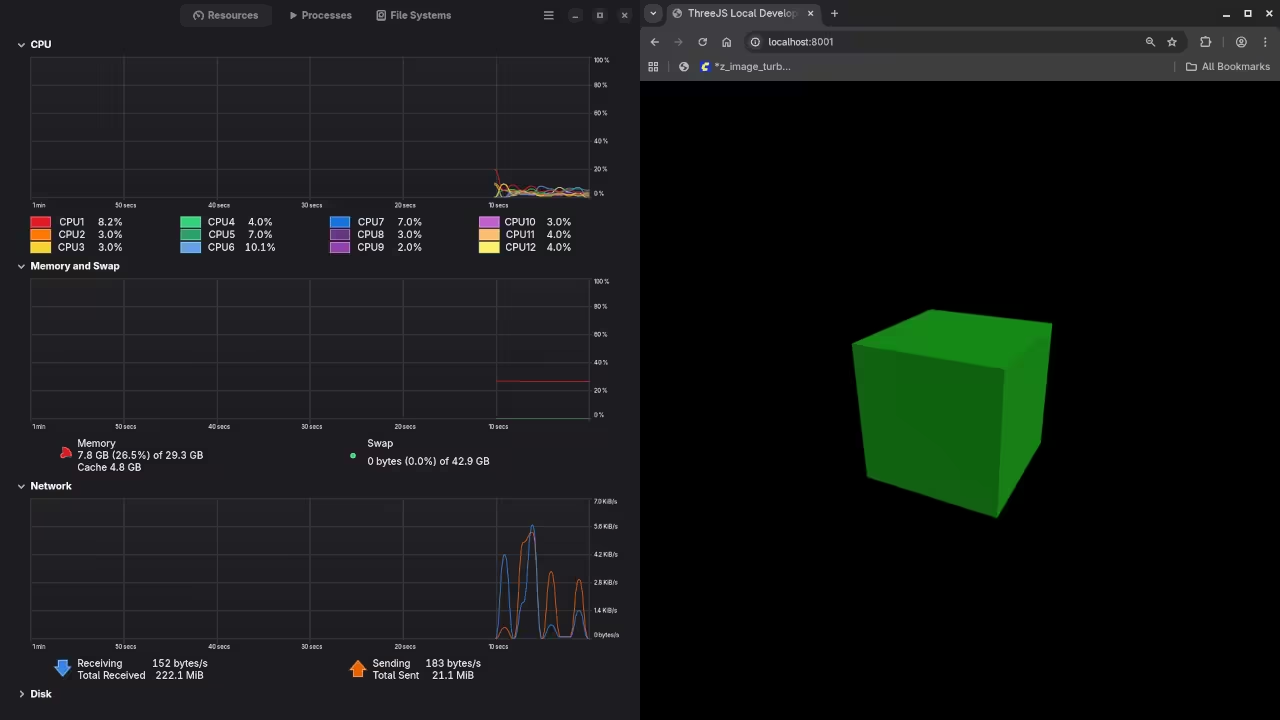
To initialize a high performance context on Fedora 44 with GNOME 50 you must ensure your environment variables are correctly exported. Use the following configuration to force the Vulkan loader to recognize your MI60 or integrated AMD hardware under Wayland.
export GSK_RENDERER=vulkan
export ADL_DEBUG_FORCE_VULKAN=1
export WEBKIT_DISABLE_COMPOSITING_MODE=0
The architectural breakthrough of combining a headless editor with a modular runtime allows for unprecedented control over asset delivery. Our previous deep dives into Raspberry Pi clusters highlighted the importance of distributed asset compression for rapid mobile loading.
By integrating these specific optimizations you ensure that your mobile web application outperforms traditional native wrappers in every metric. These architectural blueprints provide the foundation for scaling your creative vision across the entire global mobile ecosystem.
Master the Professional Stack
These specific rendering optimizations bridge the gap between hobbyist experiments and enterprise grade digital infrastructure. Mastering these blueprints ensures your projects remain compatible with the next decade of hardware evolution.
- Books (Technical Deep Dives): Explore Essential Blueprints
- Blueprints (DIY Woodworking Projects): Physical Architecture Mastery
- Tutorials (Continuous Learning): Advance Your Skills
- Consultations (Custom Architecture): Schedule Senior Architect Guidance
🚀 Recommended Resources
Disclosure: Some of the links above are referral links. I may earn a commission if you make a purchase at no extra cost to you.