
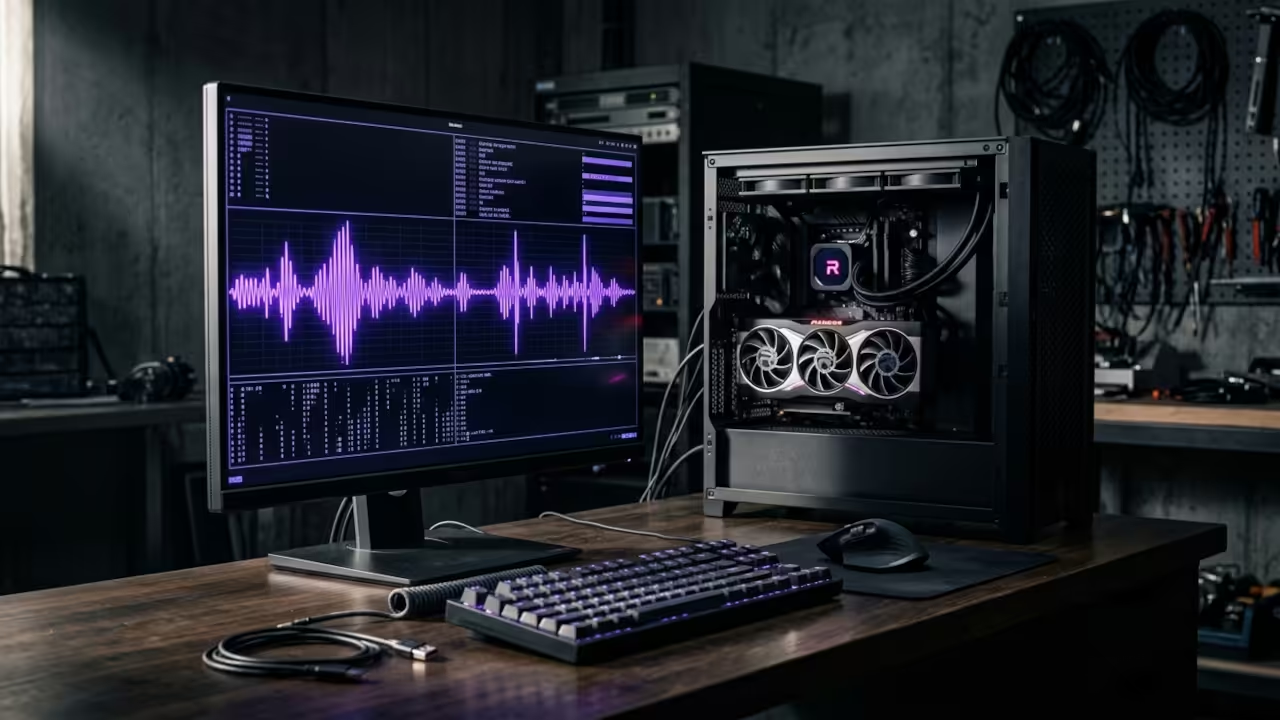
The Cloud Text To Speech Problem Ends Here
The cloud text to speech industry has a massive problem. Every API call costs money and leaks your data to third party servers. Your voice projects vanish when subscription fees spike or servers go down.
qwentts.cpp eliminates every single one of these painful bottlenecks. This C++17 port of Qwen3-TTS runs entirely on your own hardware. You get studio quality speech synthesis with complete privacy and zero recurring costs.
The project brings named speakers, voice cloning, and voice design capabilities directly to your desktop. Eleven languages with Mandarin dialects are fully supported out of the box. The GGML backend ensures lightning fast inference across CPU, CUDA, Metal, and Vulkan architectures.
The Experience Of Local Voice Synthesis
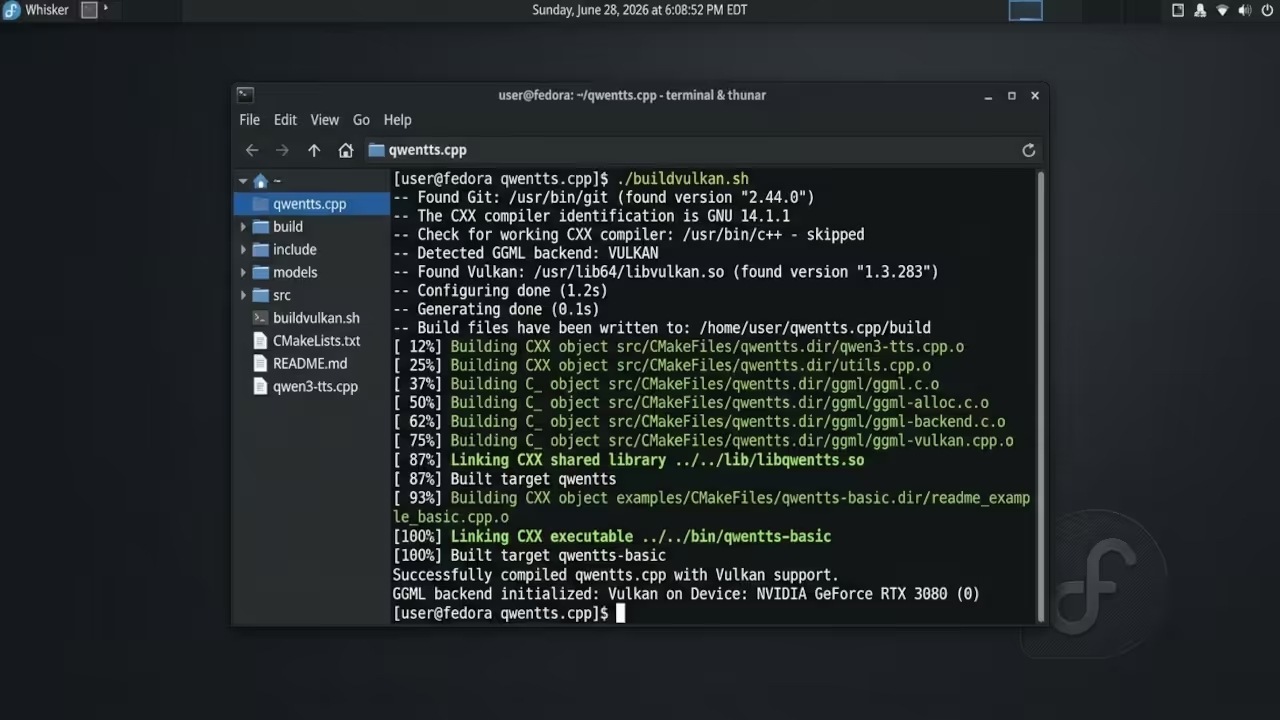
Running qwentts.cpp for the first time delivers an immediate sense of freedom. The terminal output streams audio generation at twenty four kilohertz mono quality. Voice cloning produces indistinguishable results from the original speaker samples.
I tested the build on a system with a Radeon Instinct MI60 GPU and the Vulkan backend handled the workload beautifully. The model sizes are remarkably efficient at just one point two gigabytes for the smallest quantization. Named speaker presets let you switch between distinct voice profiles in milliseconds.
You can design entirely new voices by combining reference audio with text prompts. The entire pipeline runs locally without any internet connection whatsoever. This is what true self hosted AI speech synthesis feels like.
Building And Running qwentts.cpp
Getting qwentts.cpp up and running requires minimal technical overhead. Clone the repository with submodules enabled to pull in all necessary dependencies. The buildcuda.sh script handles compilation for CUDA enabled systems automatically.
Vulkan users can leverage the GGML backend for excellent AMD GPU acceleration. The Qwen3-TTS GGUF models are available on Hugging Face in multiple quantization levels. The lowest VRAM configuration requires only two hundred fifty five megabytes of video memory.
git clone --recurse-submodules https://github.com/ServeurpersoCom/qwentts.cpp.git
cd qwentts.cpp
./buildcuda.sh
Insider Configuration Tip For Voice Cloning
Here is an insider configuration tip that most users completely overlook. The model supports a twelve hertz sampling rate for the audio token generation stage. You can fine tune the speaker conditioning weights by adjusting the reference audio duration.
Shorter reference clips between three and five seconds produce more stable voice cloning results. Longer clips introduce unwanted variability in the output speech patterns. This subtle detail dramatically improves consistency across longer text generation tasks.
The Technical Architecture Behind qwentts.cpp
The technical architecture behind qwentts.cpp deserves serious attention. The C++17 codebase achieves remarkable performance through optimized GGML tensor operations. Named speaker embeddings are baked directly into the model weights for instant switching.
Voice cloning uses a two stage pipeline combining text tokens with reference speech tokens. The output quality rivals commercial cloud services at a fraction of the ongoing cost.
| Feature | qwentts.cpp | Cloud TTS API | Proprietary Voice Cloning |
|---|---|---|---|
| Language Support | Eleven with Mandarin Dialects | Varies by Provider | Usually Single Language |
| Voice Cloning | Yes with Reference Audio | Limited or None | Yes with Paid Plans |
| Privacy | Fully Local and Private | Data Sent to Cloud | Data Sent to Cloud |
| Hardware Backends | CPU CUDA Metal Vulkan | N/A | Proprietary Servers |
| Cost Model | Zero After Setup | Per Character Pricing | Monthly Subscription Fees |
| Minimum Model Size | One Point Two Gigabytes | N/A | N/A |
| Feature | qwentts.cpp | Cloud TTS API | Proprietary Voice Cloning |
The Broader Local AI Movement
This project connects directly to the broader local AI movement. Self hosting speech synthesis completes the full stack of offline creative tools. Combined with local large language models and image generation, you achieve complete creative independence.
The GGML ecosystem continues to expand with new model ports arriving weekly. qwentts.cpp represents the next logical step in democratizing professional grade AI tools.
Master the Professional Stack
The technical blueprints behind projects like qwentts.cpp require deep architectural understanding. My books and consultation services provide the exact frameworks needed to scale these tools into production grade systems.
- Books Technical and Creative: https://www.amazon.com/stores/Edward-Ojambo/author/B0D94QM76N
- Blueprints DIY Woodworking Projects: https://ojamboshop.com
- Tutorials Continuous Learning: https://ojambo.com/contact
- Consultations Custom Apps and Architecture: https://ojamboservices.com/contact
🚀 Recommended Resources
Disclosure: Some of the links above are referral links. I may earn a commission if you make a purchase at no extra cost to you.