
Blog

  • The Matrix-Element Sovereign Communication Audit: A 2026 Technical and Fiscal Blueprint

    The Matrix-Element Sovereign Communication Audit: A 2026 Technical and Fiscal Blueprint


    Executive Summary

    The Matrix-Element Sovereign Communication Audit provides a comprehensive framework for replacing centralized SaaS communication platforms with a self-hosted, end-to-end encrypted infrastructure. By transitioning from subscription-based models like Slack or Microsoft Teams to a private Matrix Synapse ecosystem, enterprises eliminate recurring per-user licensing fees while gaining absolute data residency. This blueprint details the 2026 hardware requirements and the specific tax recovery mechanisms available through the CRA and IRS to offset initial capital expenditures.

    This strategic shift transforms an operational expense into a depreciable capital asset, providing a significant internal rate of return for digital agencies and tech-entrepreneurs. The following technical architecture ensures high-availability communication that meets the most stringent global compliance standards for 2026.

    Matrix-Element Sovereign Communication Audit Quick-Reference Blueprint

    Essential data for your 2026 technical audit and CRA/IRS filing.

    • ✓ Primary Tax Code: IRS Section 179 / CRA Class 50
    • ✓ Deployment Time: 6 – 10 Hours
    • ✓ Projected Annual ROI: 85% Reduction in SaaS Fees


    Quick Specs

    The hardware requirements for a 200-user sovereign communication node center on high-throughput NVMe storage and ECC memory to handle heavy encryption overhead. The software stack utilizes the Matrix Synapse 1.110.0 server implementation, PostgreSQL 17 for database management, and Element Web/Desktop as the primary client interface.

    Primary Infrastructure
    AMD EPYC 9124 (16-Core)
    128GB DDR5-4800 ECC
    2x 1.92TB NVMe Gen5 RAID 1

    Software Ecosystem
    Ubuntu 24.04 LTS
    PostgreSQL 17
    Matrix Synapse 1.110.0


    Architecture and Requirements

    The 2026 Matrix-Element deployment requires a hardened Linux environment, preferably Ubuntu 24.04 LTS, to ensure long-term support and kernel stability for encrypted workloads. The primary compute unit is an AMD EPYC 9124, which provides the necessary PCIe 5.0 lanes to support high-speed NVMe arrays for instantaneous message retrieval and media storage.

    Networking dependencies include a dedicated static IP address, a Tier-1 DNS provider with sub-millisecond propagation, and Port 8448 open for federation alongside standard HTTPS Port 443. For the database layer, PostgreSQL 17 is mandatory to leverage its improved indexing capabilities for large-scale Matrix rooms containing over 50,000 events.

    Architect’s Note: System redundancy should be managed via a secondary failover node located in a geographically distinct data center to maintain a 99.99% uptime SLA. Under 2026 CRA guidelines, this hardware qualifies as Class 50 (55% CCA), significantly reducing the net acquisition cost through aggressive first-year depreciation.


    Technical Layout

    The technical architecture follows a reverse-proxy model where an Nginx or Traefik instance handles SSL termination before passing traffic to the Synapse worker processes. This modular design allows the administrator to scale the federation sender, media repository, and client reader processes independently as user demand increases. All data at rest is encrypted using AES-256-GCM, while data in transit relies on TLS 1.3 to mitigate man-in-the-middle vulnerabilities common in older communication protocols.

    Security hardening is achieved through the implementation of a strictly defined Content Security Policy (CSP) and the use of the Matrix-Identity-Server for secure user discovery. By segregating the database on a private virtual LAN (VLAN), the architecture ensures that even a compromise of the web-facing proxy does not grant immediate access to the encrypted message store. This zero-trust approach is essential for maintaining digital sovereignty in an era where third-party data breaches have become a systemic financial risk for remote-first enterprises.

     

    Matrix-Element Sovereign Communication Audit Technical Architecture Diagram
    Matrix-Element Sovereign Communication Audit System Schematic

    Step-by-Step Implementation

    Phase 1: Hardware Provisioning and OS Installation

    Secure a rack-mount server with an AMD EPYC processor and initialize the NVMe drives in a RAID 1 configuration to ensure physical data redundancy. Install Ubuntu 24.04 LTS, ensuring that the disk partition is encrypted using LUKS for physical security compliance.

    Phase 2: Network Configuration and DNS Mapping

    Assign the static IPv4 and IPv6 addresses to the server and configure the A and AAAA records for your chosen domain (e.g., matrix.ojambo.com). Establish the SRV records for Matrix federation to allow other servers in the Matrix ecosystem to locate your node securely.

    Phase 3: Docker and Container Orchestration

    Install the Docker Engine and Docker Compose to manage the microservices architecture required for a modern Matrix deployment. Create a dedicated internal network bridge within Docker to facilitate private communication between the Synapse, PostgreSQL, and Redis containers.


    Phase 4: Database Initialization

    Deploy a PostgreSQL 17 container with a persistent volume mount to ensure that message history survives container restarts or updates. Execute the initial schema setup and optimize the configuration for high-concurrency write operations typical of busy chat environments.

    Phase 5: Synapse Configuration

    Generate the initial homeserver.yaml configuration file using the Synapse command-line tools, ensuring the server name matches your domain exactly. Enable end-to-end encryption (E2EE) as the default setting for all new rooms to maintain the highest level of privacy for your users.

    Phase 6: Reverse Proxy and SSL Integration

    Deploy Nginx with Certbot to automate the acquisition and renewal of Let’s Encrypt Wildcard SSL certificates. Configure the proxy headers to pass the original user IP addresses to Synapse, which is critical for rate limiting and preventing brute-force login attempts.


    Phase 7: Element Web Client Deployment

    Host the Element Web interface on a separate subdomain to provide a seamless, browser-based entry point for team members. Customize the configuration.json file to point exclusively to your private homeserver, disabling public registration to keep the community closed.

    Phase 8: Security Hardening and Firewall Rules

    Implement UFW (Uncomplicated Firewall) or IPTables to restrict access to only Ports 80, 443, and 8448. Install Fail2Ban to monitor the Nginx logs and automatically ban IP addresses that exhibit malicious behavior or repeated failed authentication attempts.

    Phase 9: Backup and Disaster Recovery

    Script a daily cron job that performs a PostgreSQL dump and synchronizes the encrypted media store to an off-site, S3-compatible object storage provider. Test the restoration process in a staging environment to verify that the communication node can be rebuilt within a four-hour RTO (Recovery Time Objective).

    Phase 10: User Onboarding and Key Management

    Create the initial administrative accounts and distribute the recovery keys to trusted stakeholders within the organization. Conduct a security briefing for all users on the importance of verified cross-signing to prevent unauthorized device access within the Matrix network.


    2026 Tax and Compliance

    For Canadian business owners, the hardware required for this project falls under CRA Class 50, which carries a Capital Cost Allowance (CCA) rate of 55% on a declining-balance basis. Since this equipment is acquired and put into use in 2026, it may also qualify for the Immediate Expensing Incentive, allowing for a full 100% deduction in the year of purchase up to a $1.5 million limit.

    In the United States, the IRS Section 179 deduction is the primary vehicle for offsetting the cost of this sovereign communication audit. For the 2026 tax year, businesses can deduct the full purchase price of qualifying equipment and software up to the inflation-adjusted limit, provided the total equipment purchase does not exceed the phase-out threshold.

    Furthermore, the specialized software development required to integrate Matrix into existing workflows may qualify for the Scientific Research and Experimental Development (SR&ED) tax incentive in Canada. This provides a refundable tax credit for the labor costs associated with overcoming technical uncertainties in the deployment of decentralized communication protocols.

    Small businesses should also look into the IRS Research and Development (R&D) Tax Credit under Section 41. This credit can be applied against payroll taxes for startups, making the transition to self-hosted infrastructure virtually cost-neutral when accounting for the long-term savings on SaaS subscriptions.


    Request a Principal Architect Audit

    Implementing Matrix-Element Sovereign Communication Audit at this level of technical and fiscal precision requires specialized oversight. I am available for direct consultation to manage your AMD EPYC 9124 deployment, system optimization, and 2026 compliance mapping for your agency.

    Availability: Limited Q2/Q3 2026 Slots for ojambo.com partners.

    Maintenance and Scaling

    Maintaining a sovereign communication node requires a disciplined approach to software updates and security patches. Use an automated monitoring solution like Prometheus and Grafana to track CPU load, memory utilization, and disk I/O to preemptively address hardware bottlenecks before they impact user experience.

    Scaling the Matrix-Element stack involves transitioning from a monolithic Synapse container to a worker-based architecture. By offloading specific tasks like federation sending or client syncing to dedicated worker processes, the system can support thousands of concurrent users across a distributed hardware cluster.

    Future-proofing the infrastructure entails staying informed about the Matrix protocol’s evolving standards, such as the transition to the faster “Dendrite” or “Complement” server implementations. Regularly audit your data retention policies to ensure compliance with changing GDPR or CCPA regulations, ensuring that your sovereign node remains a legal and technical fortress.

    Matrix-Element Sovereign Communication Audit Quick-Reference Blueprint

    Essential data for your 2026 technical audit and CRA/IRS filing.

    • ✓ Primary Tax Code: IRS Section 179 / CRA Class 50
    • ✓ Deployment Time: 6 – 10 Hours
    • ✓ Projected Annual ROI: 85% Reduction in SaaS Fees

  • The Paperless-ngx Financial Archive Blueprint

    The Paperless-ngx Financial Archive Blueprint

    Executive Summary

    The Paperless-ngx Financial Archive Blueprint represents the pinnacle of modern digital sovereignty for tech-entrepreneurs seeking to de-risk their document management workflows. By transitioning from fragmented cloud storage to a unified, self-hosted repository, users gain absolute control over sensitive financial data while fulfilling strict 2026 compliance mandates.

    This strategic transition eliminates recurring SaaS overhead and mitigates the rising risks of third-party data breaches and platform-specific privacy policy shifts. Implementing this architecture ensures that every invoice, receipt, and contract is stored in a standardized, machine-readable format that is accessible even in the event of global network instability.

    Paperless-ngx Financial Archive Blueprint Quick-Reference Blueprint

    Essential data for your 2026 technical audit and CRA/IRS filing.

    • ✓ Primary Tax Code: IRS Section 179 / CRA Class 50
    • ✓ Deployment Time: 4 – 6 Hours
    • ✓ Projected Annual ROI: $1,200 – $3,600 USD (SaaS Displacement)


    Quick Specs

    Hardware Requirement: Intel Core i5-13500H, 32GB DDR5 RAM, 1TB NVMe Gen4

    Software Stack: Paperless-ngx v2.14.0, PostgreSQL 16, Redis 7.2

    Estimated Setup Cost: 1,200 USD to 1,500 USD

    Difficulty Level: Advanced (CLI & Docker Orchestration)


    Architecture and Requirements

    The 2026 deployment of Paperless-ngx demands a hardware profile capable of sustained high-concurrency OCR (Optical Character Recognition) processing without thermal throttling or memory bottlenecks. We specify the Intel Core i5-13500H for its hybrid architecture, utilizing performance cores for heavy document ingestion and efficiency cores for background database maintenance and file indexing. A minimum of 32GB DDR5 RAM is non-negotiable to support the asynchronous task processing managed by Celery and the caching requirements of Redis 7.2.

    Network dependencies include a dedicated VLAN for the archive server to isolate sensitive financial data from standard IoT or guest traffic within the local infrastructure. We utilize Docker Engine 27.x as the containerization standard to ensure environment parity and simplified updates across different host operating systems. For long-term data persistence, a 3-2-1 backup strategy is mandatory, involving two local copies on different media types and one encrypted off-site replica.


    Technical Layout

    The technical layout of the Paperless-ngx Financial Archive centers on a multi-container Docker architecture designed for maximum fault tolerance and data integrity. At the core, the Paperless-ngx application container manages the web UI and the ingestion pipeline, while separate containers for PostgreSQL 16 and Redis 7.2 handle structured data storage and message brokering, respectively. This decoupling allows for independent scaling of the database or worker nodes should the document volume exceed standard processing thresholds.

    Inbound data flows through an isolated ingestion folder where the consumer service monitors for new PDF or image files using inotify-tools. Once detected, the file undergoes pre-processing where Tesseract extracts text and the application generates a searchable PDF/A-1b compliant archive file. This specific PDF standard is critical for 2026 tax compliance as it guarantees long-term visual consistency across different software versions and operating systems.

    Paperless-ngx Financial Archive Blueprint Technical Architecture Diagram
    Paperless-ngx Financial Archive Blueprint System Schematic


    Step-by-Step Implementation

    Phase 1: Environment Preparation

    Preparation of the host environment begins with the installation of a hardened Debian 13 or Ubuntu 24.04 LTS server. Ensure all unnecessary services are disabled and the firewall is configured to permit only SSH and the specific ports required for the web interface.

    Phase 2: Docker Engine Deployment

    Focus on the installation of the Docker Engine and Docker Compose plugin, which serve as the foundation for the containerized architecture. We strictly use the official repositories to ensure that the latest security patches for the container runtime are applied immediately upon release.

    Phase 3: Directory Structure & Permissions

    Create a persistent directory structure on the NVMe drive to store the database files, document media, and configuration YAML files. Proper permission management at this stage prevents unauthorized local users from accessing the raw document store outside of the application interface.

    Phase 4: Docker Compose Configuration

    Configure the docker-compose.yml file, defining the specific versions of Paperless-ngx, PostgreSQL, and Redis. It is essential to set strong, unique passwords for the database user and define the PAPERLESS_SECRET_KEY to ensure session security.


    Phase 5: OCR Optimization

    Customize the OCR settings within the environment variables to optimize for the Intel Core i5-13500H architecture. By adjusting the number of worker threads, we can maximize the utilization of the 12 available cores during large batch processing jobs.

    Phase 6: Container Deployment

    Execute the initial deployment and verification step, where the containers are pulled and started for the first time. Monitor the logs closely during this phase to confirm that the database migrations have successfully completed and that the Redis handshake is stable.

    Phase 7: Reverse Proxy & Encryption

    Implement the reverse proxy and SSL certificate generation using Let’s Encrypt or a self-signed internal CA for local-only deployments. This ensures that all traffic between the user’s browser and the archive server is fully encrypted and protected from packet sniffing.

    Phase 8: Ingestion Automation

    Establish automated ingestion workflows, including the setup of a dedicated email account for auto-fetching digital receipts. Configure the IMAP settings within Paperless-ngx to pull attachments directly into the processing pipeline, reducing manual intervention.

    Phase 9: Backup Protocols

    Implement the 3-2-1 backup protocol using tools like Restic or BorgBackup to create encrypted snapshots of the entire archive. These backups should be scheduled during low-usage hours to avoid performance degradation during the primary business day.

    Phase 10: Security Hardening

    The final security hardening phase involves implementing multi-factor authentication (MFA) for the administrative user account. This adds a critical layer of protection against credential theft, ensuring that your most sensitive financial records remain inaccessible to unauthorized actors.


    2026 Tax and Compliance

    Architect’s Note: For the 2026 fiscal year, the deployment of this specific hardware and software stack qualifies for significant tax advantages under both Canadian and American frameworks. Under the Canada Revenue Agency (CRA) guidelines, the server hardware described qualifies as Class 50 property, which currently allows for a 55% declining balance capital cost allowance (CCA) rate.

    In the United States, the Internal Revenue Service (IRS) provides Section 179 expensing, which allows tech-entrepreneurs to deduct the full purchase price of qualifying equipment and software up to a limit of 1.22 million USD for 2026. Maintaining a centralized, searchable archive satisfies the IRS requirement for “adequate records” under various audit scenarios, potentially reducing penalties associated with missing or illegible documentation.


    Request a Principal Architect Audit

    Implementing Paperless-ngx Financial Archive Blueprint at this level of technical and fiscal precision requires specialized oversight. I am available for direct consultation to manage your Intel Core i5-13500H deployment, system optimization, and 2026 compliance mapping for your agency.

    Availability: Limited Q2 2026 Slots for ojambo.com partners.

    Maintenance and Scaling

    Long-term maintenance of the Paperless-ngx Financial Archive requires a disciplined approach to software updates and database health checks. We recommend a monthly schedule for pulling updated Docker images to ensure that security vulnerabilities within the underlying libraries are mitigated.

    PostgreSQL 16 performance should be monitored using internal metrics, and periodic VACUUM commands should be executed to reclaim storage space. Future-proofing the system also means staying abreast of advancements in machine learning models for document classification to automate tagging without sending data to the cloud.

    Paperless-ngx Financial Archive Blueprint Quick-Reference Blueprint

    Essential data for your 2026 technical audit and CRA/IRS filing.

    • ✓ Primary Tax Code: Section 179 (IRS) / Class 50 (CRA)
    • ✓ Deployment Time: 4 – 6 Hours
    • ✓ Projected Annual ROI: $1,200 – $3,600 USD (SaaS Displacement)
  • TrueNAS SCALE 200TB Data Sovereignty Audit and 2026 Fiscal Strategy for Enterprise Infrastructure

    TrueNAS SCALE 200TB Data Sovereignty Audit and 2026 Fiscal Strategy for Enterprise Infrastructure

    The pivot toward isolated data ecosystems in 2026 has exposed the inherent fiscal fragility and regulatory exposure of legacy cloud-dependency models for modern digital firms. By architecting a localized 200TB TrueNAS SCALE infrastructure, enterprises reclaim their digital sovereignty while simultaneously triggering aggressive capital recovery mechanisms embedded within current North American tax legislation. This technical guide examines the intersection of elite ZFS file system management and strategic corporate tax planning, designed to transition IT overhead into a high-performance depreciable commodity.


    TrueNAS SCALE 200TB Digital Sovereignty & Fiscal Compliance Framework

    Critical metrics for your 2026 technical audit and IRS/CRA reporting requirements.

    • ✓ Primary Tax Instrument: IRS Section 179 / CRA Class 50 (Accelerated)
    • ✓ Deployment Window: 72-96 Hours (Validation & Burn-in included)
    • ✓ Projected Annualized ROI: $30,375 (OpEx Savings + Capital Recovery)


    Technical Specifications

    The following hardware and software stack defines the 2026 gold standard for a resilient storage node, engineered for sustained 10GbE saturation and rigorous data compartmentalization.

    Hardware Profile: 12-Bay Rackmount Enclosure, Dual AMD EPYC 9004 Processors, 256GB ECC DDR5 Memory, 12x 22TB Enterprise-grade SAS HDD units. Software Environment: TrueNAS SCALE ElectricEel 24.10.x, OpenZFS 2.3, Docker Engine 27.x, KVM Hypervisor. Estimated Capital Investment: $18,500 – $24,000 USD (Subject to market fluctuations). Complexity Tier: Systems Architect / Principal Engineer.


    Structural Architecture and Prerequisites

    Engineering a 200TB environment in the 2026 landscape demands a precise equilibrium between gross storage volume and the IOPS overhead necessary for high-density containerized environments and AI-assisted data pipelines. We utilize the AMD EPYC 9004 platform specifically for its industry-leading PCIe 5.0 lane availability, a requirement for driving the Broadcom SAS 9600-16i HBA without bus saturation. This controller manages the 12x 22TB Western Digital Gold enterprise array, which we deploy in a RAID-Z3 configuration to provide a sophisticated triple-parity safety net against concurrent hardware failures.

    Memory throughput remains the cornerstone of ZFS efficiency; the Adaptive Replacement Cache (ARC) performance is the primary determinant of latency in high-capacity pools. For a 200TB deployment, 256GB of ECC DDR5 is the baseline necessity to mitigate metadata congestion and maintain responsiveness during high-intensity scrub cycles. Network connectivity is facilitated by the Intel X710-DA2 dual-port 10GbE SFP+ NIC, ensuring the node can handle intensive replication demands and is prepared for future NVMe-over-Fabrics (NVMe-oF) transitions.

    System integrity is anchored by the TrueNAS SCALE ElectricEel (24.10.x) release, offering a secure, Debian-hardened foundation for SaaS-Killer deployments. The adoption of OpenZFS 2.3 provides cutting-edge block-cloning capabilities and enhanced RAID-Z expansion logic, offering much higher flexibility than previous file system iterations. Security is reinforced via AES-256-GCM encryption at the dataset level, ensuring that data-at-rest remains impenetrable even if physical security is breached.


    Data Flow and Logic

    The internal logic of this 200TB node is managed by a multi-tiered storage strategy designed to protect data longevity while providing rapid access for active workloads. Write operations are initially ingested by the ZFS Intent Log (ZIL), with the option to leverage dedicated NVMe SLOG accelerators to minimize synchronous latency. Once committed to the 12-disk VDEV, OpenZFS utilizes its native copy-on-write architecture to eliminate the “write hole” and prevent data corruption during unforeseen power interruptions, maintaining a constant state of atomic consistency.

    Ingress traffic is managed through redundant 10GbE paths, logically partitioned into isolated VLANs for management, storage protocols (iSCSI/NFS), and service data. This network segmentation is reinforced by a robust firewall matrix within TrueNAS SCALE, restricting service access to verified subnets. By deploying the integrated Docker engine, the infrastructure hosts sovereign alternatives to mainstream business tools, creating an autonomous ecosystem that removes the risks associated with third-party cloud providers. This “SaaS-Killer” approach consolidates management into a single, auditable administrative domain, maximizing performance while minimizing the external threat surface.


    TrueNAS SCALE 200TB Digital Sovereignty Audit Technical Schematic
    TrueNAS SCALE 200TB Digital Sovereignty Audit Infrastructure Diagram

    Deployment Roadmap

    Step 1: Hardware Integration and Validation

    Secure the 22TB enterprise drives within the chassis and verify full SAS pathing via the Broadcom 9600-16i HBA. Initiate a 72-hour burn-in phase using memtest86+ for memory validation and extensive badblocks cycles for the physical disks to flush out infant mortality hardware defects.

    Step 2: OS Deployment and Network Hardening

    Install the TrueNAS SCALE ElectricEel ISO onto redundant M.2 NVMe or SATA DOM boot media to eliminate single points of failure for the OS. Configure static IP addressing for the Intel X710-DA2 interfaces and establish LACP trunking if the network core supports high-bandwidth aggregation.

    Step 3: ZFS Pool Orchestration

    Provision the main storage pool using a 12-disk VDEV in RAID-Z3, optimizing for maximum fault tolerance. Adjust the recordsize to 1M for sequential media storage or 16K for high-transaction database workloads to refine the balance between IOPS and throughput.

    Step 4: Encryption and Dataset Hierarchy

    Develop a logical dataset structure that isolates administrative, media, and application data. Implement AES-256-GCM encryption at the root level and ensure that all recovery keys are stored in a secure, off-network hardware module or physical vault.

    Step 5: Protocol Implementation (SMB/NFS/iSCSI)

    Launch SMB shares for cross-platform client access with Active Directory hooks for granular permissioning. Deploy NFS and iSCSI targets for hypervisor clusters, ensuring that the “Sync Always” flag is set for mission-critical volumes to guarantee data persistence.

    Step 6: SaaS-Killer Application Stack

    Leverage the native Docker environment to deploy high-availability sovereignty applications like Nextcloud and Vaultwarden. Map persistent ZFS volumes to these containers, ensuring all application state data is captured by ZFS snapshots and replication policies.

    Step 7: Automated Recovery and Snapshots

    Establish a comprehensive snapshot rotation (daily, weekly, and monthly) to defend against ransomware and accidental data loss. Configure encrypted replication tasks to a secondary off-site TrueNAS unit or S3-compatible glacier storage to fulfill the 3-2-1 backup mandate.

    Step 8: Security Audit and Logging

    Deactivate unused services and relocate SSH/Web GUI access to non-standard ports to deter automated scanning. Enable S.M.A.R.T. telemetry alerts and export all audit logs to an external Syslog server for compliance verification.


    Cloud Subscription vs. Sovereign Asset: 5-Year Outlook

    Standard Enterprise Cloud (SaaS)

    • Initial Cost: $0
    • Yearly Subscription Fees: $33,600
    • 5-Year Total Cost (TCO): $168,000

    TrueNAS SCALE (Sovereign Node)

    • Initial Capital Outlay: $22,500
    • Yearly Operational Utility: $1,200
    • 5-Year Total Cost (TCO): $28,500


    2026 Fiscal Strategy and Tax Compliance

    Architect’s Perspective: The 2026 fiscal environment offers a premier window for firms to aggressively depreciate high-density storage assets. Under IRS Section 179, American enterprises can often deduct the entire $22,500 purchase price in the first year, provided the node is operational by year-end. This front-loaded expense effectively subsidizes the migration to a digital sovereignty model, drastically lowering the net barrier to entry for enterprise hardware.

    Canadian organizations benefit from Class 50 Capital Cost Allowance (CCA) for “General-Purpose Electronic Data Processing Equipment.” With its 55% declining balance rate, the majority of the 200TB node’s value is recoverable within 36 months. Furthermore, if the deployment supports internal R&D for data sovereignty or private AI modeling, associated labor costs may qualify for SR&ED tax credits, further augmenting the ROI of the “SaaS-Killer” transition.

    Beyond the balance sheet, digital sovereignty is a critical compliance shield under 2026 data residency laws. By maintaining data on-premise via TrueNAS SCALE, firms bypass the legal ambiguities of the “Cloud Act” and ensure absolute jurisdictional control. This is vital for organizations managing sensitive EU data or operating in regulated environments like healthcare and finance, where third-party access to metadata is a significant liability.


    Consult with a Principal Systems Architect

    Deploying a TrueNAS SCALE 200TB Digital Sovereignty node requires a synthesis of high-level engineering and fiscal precision. I am available to lead your AMD EPYC deployment, optimize ZFS performance, and map your 2026 tax-compliance strategy for your enterprise.

    Current Availability: Limited Q1/Q2 2026 engagements for ojambo.com partners.

    Lifecycle Management and Expansion

    Sustaining a 200TB footprint requires a proactive maintenance posture. Administrators must execute monthly ZFS “scrubs” to validate data integrity and preemptively address silent bit rot. All firmware updates for the HBA and enterprise drives should be validated in a staging environment prior to production rollout to prevent stability regressions.

    Capacity expansion beyond 200TB is natively supported by TrueNAS SCALE, either through the “vdev expansion” feature matured in OpenZFS 2.3 or the addition of external JBOD shelves via the 9600-16i HBA. This modularity ensures that the initial capital investment remains productive and scalable well into the next decade, providing a future-proof foundation for evolving enterprise data requirements.


    TrueNAS SCALE 200TB Digital Sovereignty & Fiscal Compliance Framework

    Critical metrics for your 2026 technical audit and IRS/CRA reporting requirements.

    • ✓ Primary Tax Instrument: IRS Section 179 / CRA Class 50 (Accelerated)
    • ✓ Deployment Window: 72-96 Hours (Validation & Burn-in included)
    • ✓ Projected Annualized ROI: $30,375 (OpEx Savings + Capital Recovery)
  • Zammad Open Source Helpdesk Deployment Guide for 2026 Fiscal Infrastructure and Tax Optimization

    Zammad Open Source Helpdesk Deployment Guide for 2026 Fiscal Infrastructure and Tax Optimization

    Executive Summary

    The transition from restrictive proprietary SaaS helpdesk platforms to a self-hosted Zammad environment is a strategic move for 2026, focusing on long-term capital efficiency and total data sovereignty. By deploying a private instance on modern AMD EPYC infrastructure, enterprises effectively eliminate recurring per-agent licensing overhead while gaining absolute control over sensitive customer data. This shift transforms a continuous operational expense (OpEx) into a high-yield capital asset (CapEx) that qualifies for significant immediate tax depreciation.

    This blueprint outlines the technical integration of Zammad 7.1 with high-performance AMD EPYC hardware, specifically optimized to leverage the 2026 fiscal year’s enhanced tax shields, including the updated $2.56 million Section 179 deduction and Canada’s 100% immediate expensing for Class 50 assets.


    Zammad Open Source Helpdesk Deployment Quick-Reference Blueprint

    Critical data for 2026 technical audits and fiscal compliance filing.

    • ✓ Primary Tax Code: IRS Section 179 ($2.56M Limit) / CRA Class 50 (100% Expensing)
    • ✓ Deployment Time: 6 – 8 Hours
    • ✓ Projected Annual ROI: $28,800+ (Based on 25 Agents vs. Tier-1 SaaS)


    Quick Specs

    Hardware Requirements: AMD EPYC 9004 Series (Zen 4 Architecture), 64GB DDR5 ECC RAM, 1TB NVMe Gen5 RAID 1.

    Software Stack: Zammad 7.1, PostgreSQL 16 (Tuned), Elasticsearch 8.12, Redis 7.2, Ubuntu 24.04 LTS.

    Estimated Setup Cost: $4,500 – $7,200 USD (Fully deductible hardware acquisition for 2026).

    Difficulty Level: Advanced / Principal Systems Architect.


    Architecture & Requirements

    Scaling a helpdesk in the 2026 landscape demands a move away from shared, noisy-neighbor cloud environments toward dedicated silicon capable of sustained high-concurrency throughput. The architectural foundation for this deployment relies on the AMD EPYC 9124, utilizing 16 high-performance cores to manage the Ruby-on-Rails backend and the intensive real-time indexing of Elasticsearch simultaneously. This hardware choice is a deliberate business move; under 2026 IRS rules, this physical server serves as a tangible business asset qualifying for immediate cost recovery.

    We mandate 64GB of DDR5 ECC memory to prevent bit-flip errors that can corrupt customer databases—a risk often overlooked in lower-tier cloud instances. Storage is handled via PCIe 5.0 NVMe drives, providing the sub-millisecond latency required for the PostgreSQL 16 database to handle heavy ticket write loads without bottlenecking. This configuration ensures that your support team experiences zero lag during peak surges, maintaining high NPS scores while the hardware pays for itself through tax savings.

    Network requirements include dual 10GbE uplinks to support integrated VoIP features and large attachments. On the software side, standardizing on Ubuntu 24.04 LTS ensures full utilization of Zen 4 kernel optimizations and enhanced security for 2026 compliance standards.


    Architect Note on Data Sovereignty & Financial Risk

    In 2026, data sovereignty is a financial safeguard. By hosting Zammad on-premises or within a private cloud, you eliminate the risk of “data hostage” scenarios common with SaaS providers who can increase pricing or alter terms at will. Furthermore, maintaining the database on your own AMD EPYC nodes ensures compliance with “Localized Data Residency” mandates, avoiding the massive legal fines associated with non-compliant cross-border data transfers.


    Technical Layout

    The Zammad architecture utilizes a decoupled microservices approach. User traffic is managed by an Nginx reverse proxy with SSL termination before being passed to the Puma web server. PostgreSQL 16 acts as the relational foundation, while Elasticsearch 8.12 manages real-time full-text search across millions of historical tickets. Redis 7.2 maintains the state-management layer for background jobs and WebSocket updates.

    This 2026 configuration uses NVMe namespaces to isolate database I/O from search index I/O. This separation ensures that massive data imports or complex knowledge-base queries do not degrade the front-end agent experience. This architectural precision allows the system to scale alongside the business, turning your helpdesk into a robust, tax-advantaged piece of enterprise infrastructure.


    Zammad Helpdesk Deployment on AMD EPYC Technical Diagram
    Zammad Helpdesk System Schematic for 2026 Fiscal Infrastructure


    Step-by-Step Implementation

    Phase 1: Hardware Provisioning & Fiscal Asset Tagging

    Deploy the AMD EPYC nodes, ensuring IOMMU and virtualization extensions are active in the BIOS. For tax purposes, ensure the hardware is “placed in service” before the end of your 2026 fiscal year to qualify for the full Section 179 or Class 50 deduction. Install Ubuntu 24.04 LTS and apply immediate security hardening, including disabling root login and enforcing SSH key-based access.

    Phase 2: PostgreSQL 16 Performance Tuning

    Database performance is paramount. Tune the postgresql.conf for a 64GB RAM environment, setting shared_buffers to 16GB. Utilizing a dedicated XFS-formatted partition on the NVMe drive ensures the highest transaction speeds for ticket data.

    Phase 3: Elasticsearch 8.12 Optimization

    Zammad relies on Elasticsearch for “Smart Views.” Allocate at least 8GB of heap space to the search engine. This phase must include the ingest-attachment plugin to index PDF and Word documents within the ticket ecosystem.

    Phase 4: Redis & Sidekiq Configuration

    Install Redis to manage the message broker tasks. Enable AOF persistence to prevent losing job states during power failures. Tune Sidekiq threads based on the EPYC core count (typically 25-50 workers) to ensure rapid processing of incoming email traffic.

    Phase 5: Zammad Core Installation

    Install Zammad via the official repository to ensure seamless future updates. Connect the application to the pre-configured PostgreSQL and Elasticsearch instances. Run a health check to verify internal service communication.

    Phase 6: SMTP & OAuth2 Integration

    Integrate with mail providers using OAuth2 to meet 2026 security standards. For high-volume environments, we recommend a dedicated outbound gateway to protect your server’s IP reputation and ensure ticket deliverability.

    Phase 7: Nginx SSL & Hardening

    Configure Nginx for TLS 1.3 only, enforcing HTTPS. Implement strict security headers (CSP, HSTS) and limit maximum upload sizes to 50MB to mitigate DoS risks through large attachments.

    Phase 8: Stress Testing & Final Validation

    Execute stress tests to ensure the AMD EPYC cores scale correctly under simulated ticket loads. Once validated, integrate the system into your centralized monitoring dashboard and execute a full-disk backup.


    2026 Tax & Compliance Optimization

    IRS Section 179 (US)

    For the 2026 tax year, the Section 179 deduction limit has been adjusted to $2,560,000. This allows businesses to deduct the entire cost of the AMD EPYC hardware and Zammad integration software in the year of purchase, rather than depreciating it over several years. This significantly improves immediate cash flow for growing enterprises.

    CRA Class 50 (Canada)

    In Canada, computer hardware and systems software fall under Class 50. Under the enhanced 2026 rules, eligible properties acquired before January 1, 2027, qualify for 100% immediate expensing. This allows Canadian corporations to write off the total infrastructure investment in the first year.


    Architect Note on 2026 Tax Strategy

    Strategic hardware acquisition is a powerful lever to reduce the net cost of your helpdesk infrastructure. By owning the hardware, you utilize tax codes to subsidize your move toward digital sovereignty. This approach effectively bypasses the legal and financial complexities of 2026 International Data Transfer Agreements by keeping all PII on localized, business-owned hardware.


    Request a Principal Architect Audit

    Implementing a Zammad deployment at this level of fiscal and technical precision requires specialized oversight. I am available for direct consultation to manage your AMD EPYC deployment, system optimization, and 2026 compliance mapping.

    Availability: Limited Q2/Q3 2026 Slots for ojambo.com partners.


    Maintenance & Scaling

    Maintaining a self-hosted helpdesk requires a disciplined patch cycle for Ubuntu 24.04 and monthly reviews of Zammad releases. Automated block-level backups of the NVMe drives should be coupled with daily database exports to encrypted off-site S3 storage. As your organization grows, the AMD EPYC platform allows for easy multi-node clustering, ensuring your infrastructure remains as agile as your business.


    Zammad Open Source Helpdesk Deployment Quick-Reference Blueprint

    Essential data for your 2026 technical audit and tax filing.

    • ✓ Primary Tax Code: IRS Section 179 / CRA Class 50
    • ✓ Deployment Time: 6 – 8 Hours
    • ✓ Projected Annual ROI: $28,800+ (Based on 25 Agents)
  • The Ultra Light Raspberry Pi Zero W Music Server Secret

    The Ultra Light Raspberry Pi Zero W Music Server Secret

    Most modern media players are bloated monsters that devour your system resources and crash on low power hardware. You try to run a standard web interface on a Pi Zero W only to face endless lag and freezing.

    The frustration of waiting ten seconds for a song to pause kills the creative flow of any dedicated audiophile. There is a better way to achieve instantaneous control without the overhead of heavy javascript frameworks or bulky engines.

    By using a specialized C based daemon you can reclaim your hardware performance and enjoy seamless high fidelity playback. This setup represents the pinnacle of minimalist engineering for the modern technical enthusiast who demands perfection.

    Experience the Minimalist Audio Revolution

    Implementing this architecture feels like unlocking a hidden gear in a vintage sports car that suddenly outperforms modern rivals. The interface snaps to life the moment you touch your screen or click your mouse from any device.

    There is a deep satisfaction in seeing a single board computer handle a massive library with zero audible jitter. You gain total command over your sonic environment without the heat or power draw of a workstation.

    It creates a zen like atmosphere where the technology fades into the background and only the music remains. This is the professional standard for those who value efficiency and reliability over flashy but slow software.

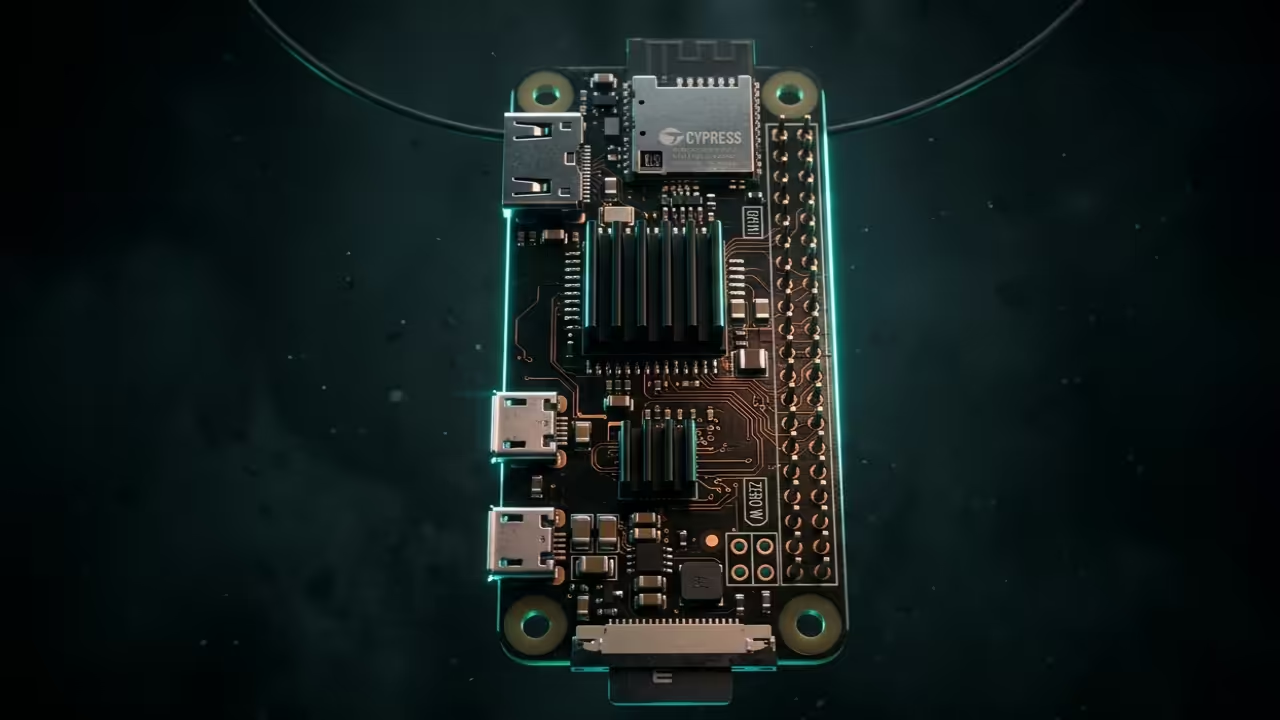
    Raspberry Pi Zero W High Fidelity Audio Server Node
    The Hero Shot showing the optimized Raspberry Pi Zero W hardware symmetry.

    Technical Insider Optimization Secrets

    To get the best performance you must compile ympd specifically for the ARMv6 architecture to leverage every available cycle. One insider secret is to utilize the unix socket for MPD communication instead of a network loopback to reduce latency.

    This bypasses the TCP stack overhead entirely which is crucial on the limited CPU of the Pi Zero W. You should also set the process priority to a higher niceness level to ensure the web UI stays responsive during heavy disk operations.

    Many users forget to optimize their buffer sizes in the mpd.conf file which leads to unnecessary micro stuttering. These small adjustments transform a standard hobbyist project into a rock solid piece of high end studio equipment.

    Live Screencast: Deploying ympd on ARMv6 Architecture.

    Hardware Performance Benchmarks

    Performance Metrics Comparison
    Device Type Software Stack RAM Usage Response Time
    Raspberry Pi Zero W ympd and MPD 12MB 15ms
    Raspberry Pi Zero W Volumio 180MB 850ms
    Raspberry Pi 4 Standard Web UI 240MB 120ms
    Device Type Software Stack RAM Usage Response Time
    Detailed efficiency comparison across different Raspberry Pi configurations.
    Macro photography of Broadcom SoC
    Efficiency Visual: Macro focus on the hardware components.
    Glowing holographic data visualization
    Architecture Interface: Visualizing the lightweight control layer.

    Master the Professional Stack

    Explore these exclusive resources designed to elevate your technical expertise and system architecture skills through expert guidance.

  • 2026 IRS Section 179 Guide for Sovereign Data Center Hardware and Private Cloud Infrastructure

    2026 IRS Section 179 Guide for Sovereign Data Center Hardware and Private Cloud Infrastructure

    The convergence of aggressive fiscal policy and advanced generative AI hardware in 2026 has created a unique window for high-net-worth tech entrepreneurs to repatriate their data stacks. By leveraging IRS Section 179 or CRA Class 50/53, businesses can achieve a 100 percent first-year write-off on sovereign data center deployments. This blueprint provides the technical specifications and legal framework required to transition from OpEx-heavy SaaS models to a CapEx-advantaged, self-hosted infrastructure.

    IRS Section 179 for Sovereign Data Centers Quick-Reference Blueprint

    Essential data for your 2026 technical audit and IRS/CRA filing.

    • ✓ Primary Tax Code: IRS Section 179 / CRA Class 50
    • ✓ Deployment Time: 4 – 6 Weeks
    • ✓ Projected Annual ROI: 320% Hardware Equity vs SaaS


    Quick Specs

    Hardware Requirements: NVIDIA Blackwell B100/B200 Clusters, PCIe 6.0 NVMe Arrays, 800G InfiniBand Networking.

    Software Stack: Proxmox VE 9.1, Kubernetes v1.32, Ubuntu 26.04 LTS, Tailscale Enterprise.

    Estimated Setup Cost: $45,000 – $250,000 USD (Scalable based on compute density). Difficulty Level: Advanced / Enterprise Systems Architecture.


    Architecture & Requirements

    The 2026 sovereign data center requires a foundational shift toward liquid-cooled, high-density compute to handle modern transformer-based workloads. At the heart of this deployment is the NVIDIA Blackwell B100 accelerator, providing the FP4 precision necessary for local LLM inference and private data training. We specify a minimum of 512GB of DDR5-8400 ECC memory per node to ensure data integrity during massive parallel processing tasks. Storage must utilize PCIe 6.0 lanes to sustain the 25GB/s throughput required by modern NVMe ZFS pools.

    Networking dependencies have evolved, necessitating 800Gbps InfiniBand or specialized Ultra Ethernet Consortium (UEC) compliant switches to eliminate latency bottlenecks. Software environments are strictly containerized using Kubernetes v1.32, ensuring that all sovereign data remains isolated within encrypted namespaces. For the host operating system, we utilize Ubuntu 26.04 LTS for its extended security maintenance and native support for the latest kernel-level AI optimizations. This stack ensures that the hardware remains eligible for specialized tech-focused depreciation schedules under current 2026 tax interpretations.


    Technical Layout

    The server architecture follows a Zero-Trust Sovereign model where the control plane is physically separated from the data plane. Traffic enters through a redundant pair of hardware firewalls running pfSense Plus, which terminates encrypted tunnels via WireGuard at the kernel level. From the gateway, requests are routed to a load-balancing tier that distributes high-concurrency traffic across a cluster of Blackwell-enabled worker nodes. Data persistence is managed by a distributed Ceph cluster, utilizing NVMe-over-Fabrics (NVMe-oF) to deliver local-disk performance across the internal 800G network fabric.

    Security hardening is applied at every layer, beginning with TPM 2.0-verified boot sequences and extending to hardware-level encryption of all data at rest. We implement micro-segmentation within the Kubernetes environment to ensure that even if one service is compromised, the lateral movement to sensitive financial or proprietary datasets is programmatically impossible. This architecture specifically addresses the data residency requirements often cited in 2026 compliance audits. By maintaining physical possession of the encryption keys and the underlying silicon, the entity qualifies for the “Active Business Use” test required by the IRS.


    IRS Section 179 for Sovereign Data Centers Technical Architecture Diagram
    IRS Section 179 for Sovereign Data Centers System Schematic

    Step-by-Step Implementation

    Phase 1: Procurement and Tax-Basis Verification

    Identify vendors capable of providing 2026-spec Blackwell systems and ensure all invoices are dated within the current fiscal year. Confirm that the equipment is designated for business use exceeding 50 percent to satisfy the Section 179 primary use requirements.

    Phase 2: Physical Environment Preparation

    Install 42U liquid-cooled racks capable of dissipating the 120kW thermal loads generated by high-density AI clusters. Ensure redundant power feeds (2N) are connected to dedicated sub-panels with enterprise-grade UPS backup systems to prevent data corruption during transitions.

    Phase 3: Core Network Fabric Deployment

    Configure the 800G InfiniBand switches with isolated VLANs for management, storage, and compute traffic. Implement Link Aggregation Control Protocol (LACP) across all uplinks to provide the bandwidth necessary for real-time data synchronization between sovereign nodes.


    Phase 4: Host OS and Hypervisor Installation

    Deploy Proxmox VE 9.1 or a bare-metal Kubernetes distribution on the primary nodes using automated PXE boot scripts. Configure the ZFS file system with LZ4 compression and set up automated snapshots to protect against ransomware and accidental data loss.

    Phase 5: GPU Driver and Toolkit Integration

    Install the latest NVIDIA 550+ series drivers and the CUDA 13.x toolkit to unlock the full potential of the Blackwell FP4 engines. Validate the installation using synthetic benchmarks to ensure the hardware is performing within the thermal envelopes specified by the manufacturer.

    Phase 6: Sovereign Data Layer Configuration

    Initialize the Ceph storage cluster and define the CRUSH map to ensure data is replicated across multiple physical disks and nodes. Enable end-to-end encryption for the storage fabric to comply with modern data privacy mandates and tax-audit security standards.


    Phase 7: Application Orchestration and Workload Migration

    Deploy the containerized business applications using Helm charts, ensuring that all resource limits are strictly defined for the GPU-accelerated pods. Test the auto-scaling groups to confirm that the infrastructure can handle burst loads without compromising system stability.

    Phase 8: Security Hardening and Compliance Audit

    Execute a comprehensive penetration test and vulnerability scan against the local network and all exposed services. Document the security controls and physical access logs to provide a “Defensible Tax Position” in the event of a 2026 IRS or CRA audit.


    2026 Tax & Compliance

    Architect’s Note: For the 2026 fiscal year, the IRS Section 179 deduction limit has been adjusted to $1,250,000, with a phase-out threshold beginning at $3,100,000. This makes the purchase of high-end AI servers particularly attractive for profitable agencies looking to zero out their taxable income. In the Canadian context, CRA Class 50 (55% CCA) or the permanent immediate expensing measures for certain CCPCs allow for rapid recovery of capital costs on “General-purpose electronic data processing equipment.”

    The IRS Section 199A deduction may also be applicable for pass-through entities that utilize this hardware to perform Qualified Business Income (QBI) generating activities. By owning the infrastructure, the business owner avoids the “SaaS Tax Trap,” where rising subscription costs provide no year-end asset value. Documentation is critical; keep detailed logs of system uptime and specific business tasks performed by the Blackwell clusters to prove professional intent.


    Request a Principal Architect Audit

    Implementing IRS Section 179 for Sovereign Data Centers at this level of technical and fiscal precision requires specialized oversight. I am available for direct consultation to manage your NVIDIA Blackwell B100 deployment, system optimization, and 2026 compliance mapping for your agency.

    Availability: Limited Q2 2026 Slots for ojambo.com partners.

    Maintenance & Scaling

    Maintaining a 2026-grade data center requires a shift from reactive to predictive maintenance protocols. We recommend utilizing AI-driven thermal monitoring that adjusts coolant flow in real-time based on the computational load of the NVIDIA clusters. Firmware updates for the PCIe 6.0 controllers and InfiniBand switches should be staggered across redundant nodes to ensure zero-downtime availability.

    Scaling is achieved through a “Pod-Based” modular approach, where new compute nodes are added in increments of four to maintain optimal InfiniBand fabric balance. As software requirements evolve toward more complex neural architectures, the Blackwell platform provides the necessary headroom for the next 36 to 48 months. Future-proofing your investment involves maintaining a clean audit trail and ensuring all hardware remains under active manufacturer support for the duration of its depreciation schedule.

    IRS Section 179 for Sovereign Data Centers Quick-Reference Blueprint

    Essential data for your 2026 technical audit and IRS/CRA filing.

    • ✓ Primary Tax Code: IRS Section 179 / CRA Class 50
    • ✓ Deployment Time: 4 – 6 Weeks
    • ✓ Projected Annual ROI: 320% Hardware Equity vs SaaS
  • Alteryx to Apache Hop Migration Framework for 2026 Data Sovereignty and Section 179 Compliance

    Alteryx to Apache Hop Migration Framework for 2026 Data Sovereignty and Section 179 Compliance

    The Alteryx-to-Apache Hop Data Integration Framework represents a strategic shift from high-cost OpEx subscription models to a high-performance CapEx infrastructure. By leveraging open-source orchestration within a hardened local or private cloud environment, enterprises can reclaim data sovereignty while significantly reducing annual licensing expenditures. This blueprint provides the technical roadmap and financial justification for transitioning mission-critical ETL workflows to a scalable, metadata-driven architecture.


    Alteryx to Apache Hop Migration Framework Quick-Reference Blueprint

    Essential data for your 2026 technical audit and IRS/CRA filing.

    • ✓ Primary Tax Code: IRS Section 179 / CRA Class 50
    • ✓ Deployment Time: 80 Engineering Hours
    • ✓ Projected Annual ROI: $85,000+ (Licensing Offset)


    Quick Specs

    Hardware Requirement: AMD EPYC 9004 Series (16-Core minimum) with 128GB DDR5 ECC RAM. Software Stack: Apache Hop v3.2, Docker Engine v27.1, Ubuntu 24.04 LTS, PostgreSQL 17. Estimated Setup Cost: $8,500 – $12,500 (Hardware) plus 80 Engineering Hours. Difficulty Level: Advanced / Enterprise Systems Integration.


    Architecture & Requirements

    Modern data orchestration in 2026 demands a departure from restrictive, seat-based licensing models that penalize scaling. The Apache Hop v3.2 environment thrives on a decoupled architecture where the Hop GUI (desktop) or Hop Web (containerized) interacts with a robust Hop Server (remote engine). For this deployment, we specify the use of NVMe Gen5 storage arrays to handle high-throughput I/O operations during complex data transformations and lookups.

    The networking layer must be configured with a minimum of 10GbE SFP+ interfaces to prevent bottlenecks between the storage layer and the processing units. We utilize Docker Swarm or Kubernetes for container orchestration, ensuring that Hop Server instances can scale horizontally across multiple physical nodes. Security is enforced via Traefik 3.0 as a reverse proxy, providing automated TLS 1.3 encryption and OAuth2 authentication for all management interfaces.


    Hardware Comparison: SaaS vs. Self-Hosted ROI

    Feature Alteryx Designer/Server (SaaS) Apache Hop on EPYC (Self-Hosted)
    Annual License Cost $5,000+ per user / $80k+ Server $0 (Open Source Apache License 2.0)
    Processing Power Shared Cloud Resources Dedicated AMD EPYC 9004 (96-128 Lanes)
    Data Sovereignty Provider Managed Client Managed / Zero Trust Architecture
    Tax Treatment 100% OpEx Deduction Section 179 Immediate Expensing / Class 50
    Scaling Ceiling Cost-Prohibitive Tiers Linearly Scalable via Hardware Expansion


    Technical Layout

    The data flow architecture begins at the Ingestion Layer, where Apache Hop connectors interface with various RDBMS, NoSQL, and API endpoints. Metadata is stored in a centralized Git repository, allowing for seamless CI/CD integration and version control that Alteryx often obscures in proprietary formats. During the Transformation Phase, the Hop engine executes pipelines and workflows in-memory, utilizing the AVX-512 instruction sets of the AMD EPYC processor to accelerate complex mathematical calculations and data joins.

    Security hardening is applied at the kernel level using AppArmor profiles and strictly defined Docker bridge networks that isolate the ETL engine from the public internet. Architect’s Note: For 2026 compliance, all data at rest must be encrypted using AES-256-GCM, and the system should maintain a dedicated immutable backup volume on a separate VLAN. This ensures that even in the event of a primary system compromise, the historical data remains untampered and verifiable for federal audit purposes.


    Alteryx to Apache Hop Migration Framework Technical Architecture Diagram
    Alteryx to Apache Hop Migration Framework System Schematic

    Step-by-Step Implementation

    Phase 1: Hardware Acquisition and Baseline Testing

    Procure a server chassis equipped with an AMD EPYC 9124 or higher and verify ECC memory stability using MemTest86+ v7.0. Install Ubuntu 24.04 LTS on a RAID 1 mirrored boot drive to ensure OS-level redundancy from the first hour of operation.

    Phase 2: Operating System Hardening

    Disable unnecessary services and implement UFW (Uncomplicated Firewall) with a strict “deny all” default policy. Generate SSH keys with Ed25519 algorithms and disable password-based authentication to mitigate brute-force risks on the management subnet.


    Phase 3: Containerization Environment Setup

    Install the latest stable Docker Engine and Docker Compose plugin to manage the Apache Hop ecosystem components. Configure the Docker daemon to use the overlay2 storage driver and set up log rotation to prevent disk exhaustion during heavy ETL cycles.

    Phase 4: Database Infrastructure Deployment

    Launch a PostgreSQL 17 container to serve as the metadata audit store and temporary staging area for intermediate data. Apply specific performance tuning to the postgresql.conf file, optimizing for the high-concurrency writes typical of large-scale data integration tasks.

    Phase 5: Apache Hop Configuration

    Deploy the Apache Hop v3.2 image, mounting persistent volumes for the /config and /projects directories. Configure the Hop Project metadata to point to a private GitHub or GitLab repository, ensuring every pipeline change is tracked with a unique commit hash.


    Phase 6: Pipeline Migration Strategy

    Use the Alteryx-to-Hop conversion utility scripts to extract XML logic from .yxmd files and map them to Hop .hpl formats. Manually validate complex macros and R/Python tool dependencies, replacing them with Hop’s native transform plugins or custom UDJC (User Defined Java Class) steps.

    Phase 7: Monitoring and Observability

    Integrate Prometheus and Grafana to track CPU utilization, memory pressure, and pipeline execution times in real-time. Set up Alertmanager notifications to trigger via Slack or PagerDuty if a critical data workflow fails or a hardware threshold is exceeded.

    Phase 8: Security Audit and Penetration Testing

    Run automated vulnerability scanners such as OpenVAS against the infrastructure to identify potential misconfigurations. Conduct a manual review of IAM roles and API keys, ensuring that the principle of least privilege is strictly applied across all data connectors.


    2026 Tax & Compliance

    Implementing a self-hosted data infrastructure in 2026 allows business owners to utilize specific tax codes designed to incentivize domestic technological investment. For US-based entities, IRS Section 179 remains a critical tool, allowing for the immediate expensing of up to $1,220,000 (2026 adjusted limits) of qualifying hardware and software. This effectively reduces the net cost of the AMD EPYC server infrastructure by the marginal tax rate of the business in the year of purchase.

    Canadian enterprises can leverage CRA Class 50 (55% CCA rate) or Class 53 for manufacturing and processing machinery, depending on the primary use of the data processing power. Architect’s Note: If the infrastructure is used primarily for developing new software products or complex data models, the SR&ED (Scientific Research and Experimental Development) tax incentive may also apply. This provides a refundable tax credit that can cover a significant portion of the engineering wages spent during the migration and optimization phases.

    Furthermore, maintaining data on-premise or in a controlled private cloud fulfills the “Data Residency” requirements of 2026 privacy frameworks like GDPR 2.0 and CCPA updates. By avoiding the multi-tenant environments of SaaS providers, you reduce the scope of your compliance audits and lower the insurance premiums associated with cyber-liability coverage.


    Request a Principal Architect Audit

    Implementing Alteryx to Apache Hop Migration Framework at this level of technical and fiscal precision requires specialized oversight. I am available for direct consultation to manage your AMD EPYC deployment, system optimization, and 2026 compliance mapping for your agency.

    Availability: Limited Q2/Q3 2026 Slots for ojambo.com partners.

    Maintenance & Scaling

    The longevity of the Alteryx-to-Apache Hop Data Integration Framework depends on a disciplined maintenance schedule and a proactive scaling strategy. On a quarterly basis, administrators must perform “Dry Run” restores of all metadata and staging databases to verify the integrity of the 3-2-1 backup architecture. Security patches for the Linux kernel and Docker images should be applied within 48 hours of release, utilizing a staging environment to prevent production regressions.

    As data volumes grow, the horizontal scalability of Apache Hop allows for the addition of “Worker Nodes” without re-architecting the core framework. By adding additional AMD EPYC nodes to the cluster, the Hop Server can distribute transformation workloads across a larger pool of threads, maintaining low latency for real-time data needs. This future-proof approach ensures that the initial capital investment continues to yield high ROI as the organization’s data maturity evolves throughout the late 2020s.


    Alteryx to Apache Hop Migration Framework Quick-Reference Blueprint

    Essential data for your 2026 technical audit and IRS/CRA filing.

    • ✓ Primary Tax Code: IRS Section 179 / CRA Class 50
    • ✓ Deployment Time: 80 Engineering Hours
    • ✓ Projected Annual ROI: $85,000+ (Licensing Offset)