
TECHNICAL OVERVIEW
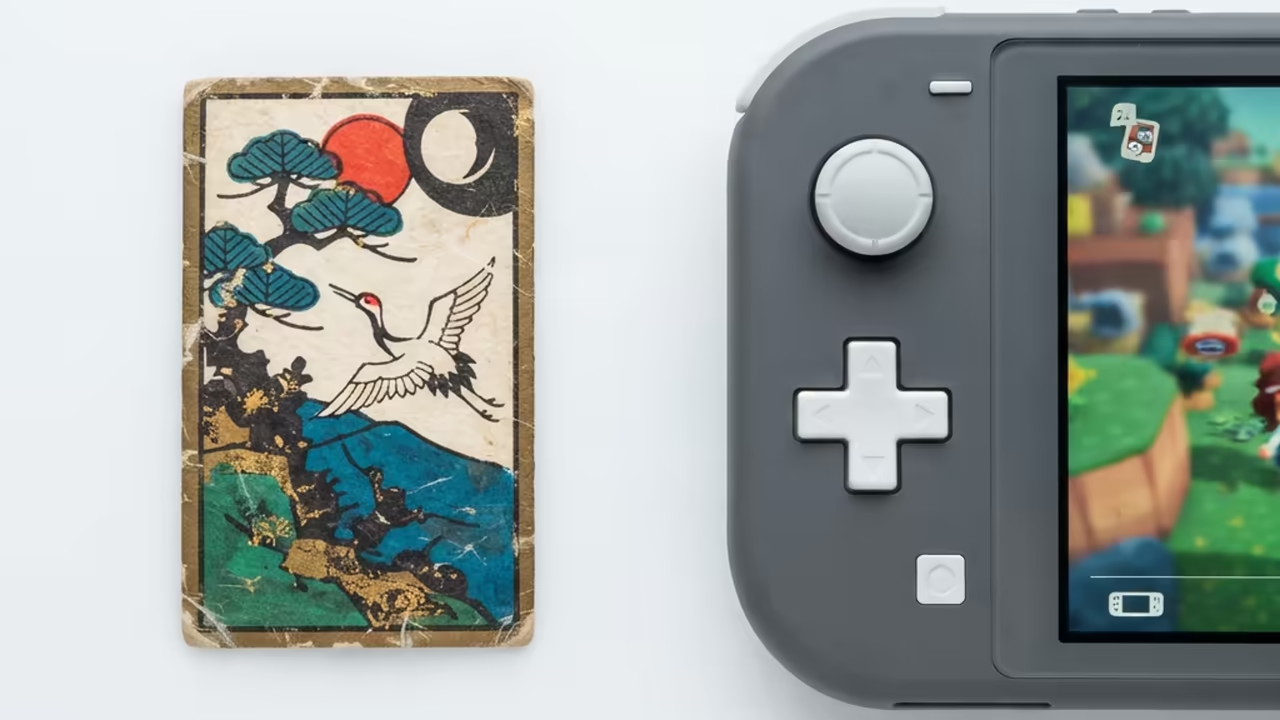
The story of the kyoto gaming titan begins in eighteen eighty nine. When establishing the historical baseline for the company one sees that it started as a small operation producing hand painted hanafuda cards. The system architecture of this early business model relied on an obsessive attention to tactile detail and operational metrics based on craftsmanship.
The auditory signature of the workshop was very specific. One can hear the rhythmic scratching of fine brushes on thick cardstock. The crisp snap of a deck being shuffled provided a satisfying sonic punctuation.
DIVERSIFICATION AND SONIC CHAOS
The mid twentieth century brought a period of extreme corporate instability. The company attempted to run taxi services and themed hotels. These ventures represented a desperate search for a new identity.
The sonic texture of this era was a chaotic mix of failure. The loud slam of vintage car doors echoed through rainy streets. The low hum of small diesel engines replaced the silence of the art studio.
In themed hotels the atmosphere was one of curated silence. This was punctuated by the whir of inefficient early vacuum cleaners. The sound of mechanical failure became a recurring theme in the corporate halls.
THE YOKOI PIVOT
The transition to a toy manufacturer began with the work of gunpei yokoi. He championed the use of lateral thinking with withered technology. This meant using affordable existing parts in creative ways.
The engineering relied on a simple but effective spring mechanism which created a sharp plastic click that was incredibly satisfying to the user.
This auditory experience marked a shift toward playful mechanical engineering. The focus moved from artistic painting to physical interaction. It was the first step toward a digital future.
SILICON ARCHITECTURE
The company pivoted to microprocessors in the late seventies. They engineered a home console that changed the industry forever. It utilized a ricoh processor based on the mosc six five zero two.
The system operated at a clock frequency of one point seven nine megahertz which allowed for precise control of on screen sprites.
This was a masterclass in cost effective silicon engineering. The auditory experience shifted to the buzz of a cathode ray tube. The chiptune melodies were generated by pulse wave channels. This created a digital symphony that defined a whole generation of players.
HANDHELD EFFICIENCY
The launch of the grey handheld device showcased a different engineering philosophy. While others chased color screens they focused on battery efficiency. This was a strategic decision based on power management.
- Low power monochrome liquid crystal display
- Efficient processor for extended battery life
- Compact grey plastic chassis
- Tactile membrane dpad
The device allowed the system to run for weeks on a few batteries. This reliability became a primary selling point for the device. The sonic signature was the subtle click of the dpad. The high pitched beeps of the internal speaker were iconic.
SYSTEM SPECIFICATIONS
| Component | Technical Detail | Sonic Property |
|---|---|---|
| CPU | Ricoh 2A09A | Digital Clock Buzz |
| RAM | 2 Kilobytes | Silent Data Flow |
| Screen | Monochrome LCD | Visual Static |
| Audio | 5 Channel PSG | Pulse Wave Beep |
| Input | Membrane DPad | Plastic Snap |
CONCLUSION
The journey from paper to pixels was not a linear path. It was a series of calculated risks and mesmerizing failures. The company survived by prioritizing the feeling of play.
The engineering was always a tool for creating an experience. From the snap of a card to the click of a button. The sonic evolution tells the story of an enduring legacy.
The lessons of the past continue to inform the future. The hum of a taxi and the whir of a vacuum were necessary. They paved the way for a global digital empire.
🚀 Recommended Resources
Disclosure: Some of the links above are referral links. I may earn a commission if you make a purchase at no extra cost to you.