
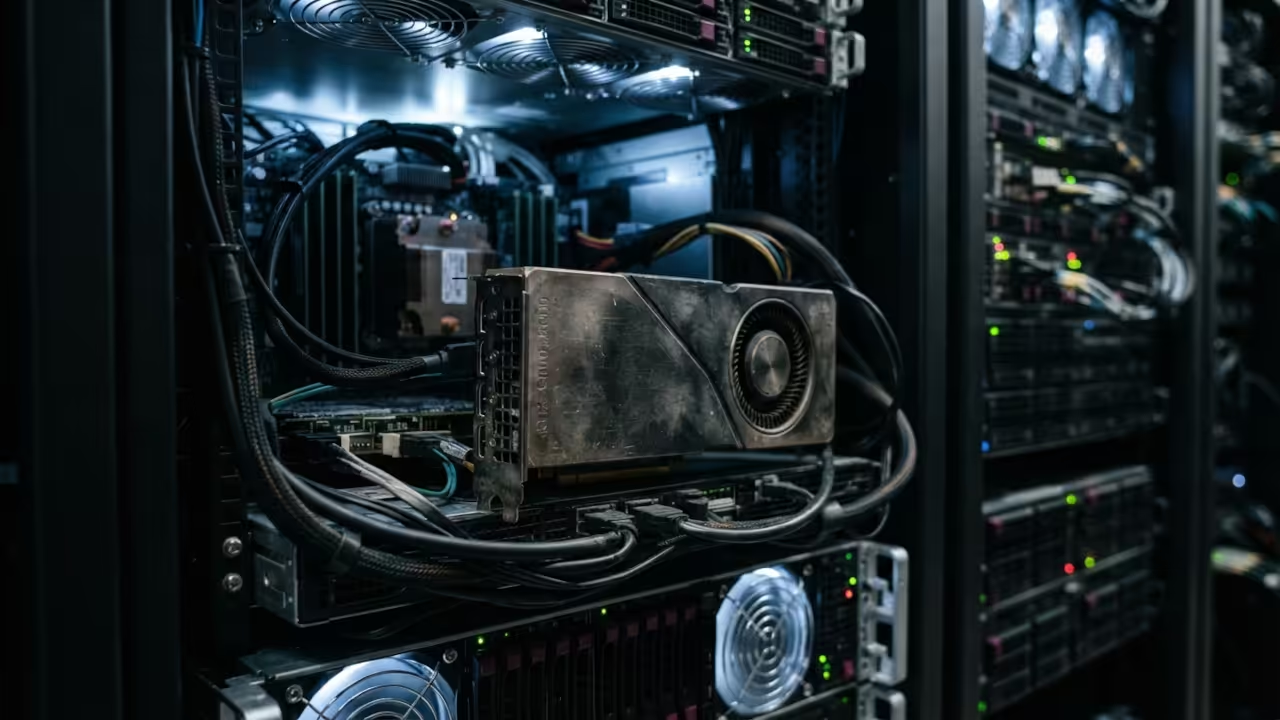
Stop wasting thousands on a new consumer GPU when a single used enterprise card delivers double the VRAM for a fraction of the cost. The AI-driven GPU shortage of 2026 has created a bizarre market inversion where old enterprise hardware now undercuts brand-new consumer silicon across almost every meaningful workload.
You can run a 70 billion parameter LLM locally for under $800 instead of paying $3000 for a card that simply cannot fit the model on its 32 GB of memory.
The frustration is real. Enthusiasts spent $2500 on an RTX 5090 only to discover their favorite 32 billion parameter model refuses to load. Meanwhile, a used Tesla P40 24GB or RTX A6000 48GB from a decommissioned server rack sits in a thrift bin for $150 to $3800 depending on the card and its provenance.
The pain point is not raw compute speed — that is still competitive on the used market — it is VRAM capacity, and the new consumer generation is criminally short on it.
The Experience of Unlocking Unloadable Models
There is nothing quite like watching a 70 billion parameter language model initialize successfully on a machine that should not have been capable of it. You press run, the tensor allocator settles, and tokens start streaming at 30 to 40 tokens per second.
That feeling of architectural breakthrough — of pushing past a hard hardware wall with clever sourcing and configuration — is what separates the informed builder from the impulse buyer.
This is not a shortcut. This is a deliberate strategy built on understanding the real constraints of local AI workloads and exploiting the secondary GPU market before it fully institutionalizes.
The result is a system that delivers professional-grade inference capability without the enterprise price tag or the cloud vendor lock-in that plagues every serious AI practitioner.
GPU Comparison: Used Enterprise vs New Consumer
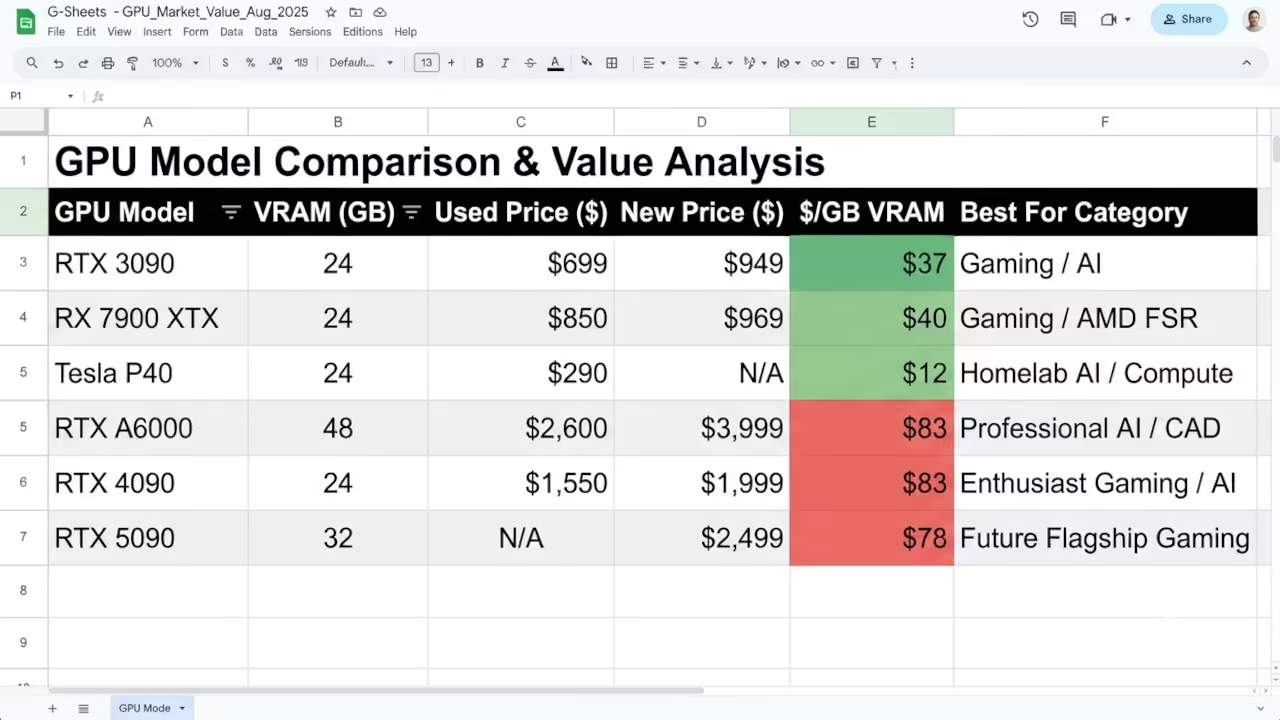
The data is unmistakable. Per-gigabyte VRAM pricing favors used enterprise cards by a margin of 2 to 10 times depending on the tier you are evaluating. The RTX 3090 at $700 used delivers the same 24 GB capacity as a new RTX 4090 or RTX 5090, yet costs less than half as much.
For inference workloads that are the dominant use case for local AI in 2026, the enterprise GPU is the rational choice.
| GPU Model | VRAM | Used Price | New Price | $/GB VRAM | Best For |
|---|---|---|---|---|---|
| RTX 3090 | 24 GB | $650-$800 | $2000+ | $27-$33 | 70B quantized LLMs |
| RX 7900 XTX | 24 GB | $550-$850 | $1000 | $23-$35 | ROCm-native inference |
| Tesla P40 | 24 GB | $150-$275 | N/A | $6-$11 | Budget batch inference |
| RTX A6000 | 48 GB | $3500-$4800 | $4850 | $73-$100 | 70B full precision |
| RTX 5090 | 32 GB | $1999+ | $2000 | $63 | 32B quantized inference |
| RTX 4090 | 24 GB | $1000-$1600 | $1999 | $42-$67 | General AI workloads |
| GPU Model | VRAM | Used Price | New Price | $/GB VRAM | Best For |
The VRAM Ceiling Problem
Every serious AI practitioner has hit the wall. You quantize your model to Q4, you quantize to Q5, you even try Q8 — and the model still refuses to fit. The RTX 5090 at 32 GB is a step up, but it is still a step up from where the real work lives.
A 70 billion parameter model at full or near-full precision requires 48 GB to 60 GB of VRAM. The RTX A6000 delivers exactly that at 48 GB for roughly $3500 to $4800 used, which is still less than the new price of an RTX 5090 even after accounting for the VRAM advantage.
The specific technical configuration tip that unlocks this entire strategy is the Ollama model configuration file. You can declare memory limits that force Ollama to offload layers to system RAM when VRAM is insufficient, and the RTX A6000 with its wider memory bus handles the layer swapping far more efficiently than consumer cards with narrower interfaces.
This is not a hypothetical optimization — it is a real performance multiplier that turns a 32 GB card into a 48 GB card by managing the memory hierarchy intelligently.
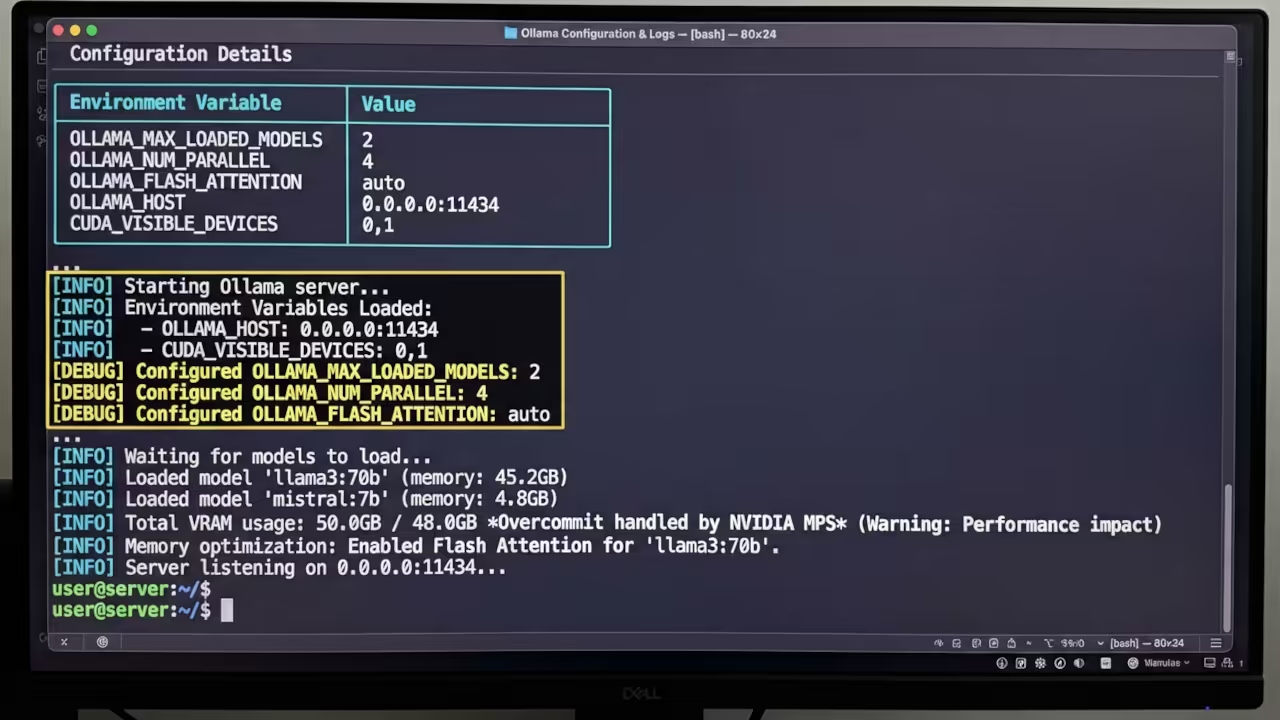
OLLAMA_MAX_LOADED_MODELS=2
OLLAMA_NUM_PARALLEL=4
OLLAMA_FLASH_ATTENTION=auto
Setting these environment variables before launching your inference session ensures Ollama exploits every available byte of VRAM before spilling to system memory. The RTX A6000 benefits particularly from this because its 384-bit memory interface maintains throughput even during the layer migration overhead that narrower consumer cards suffer under.
The Enterprise Provenance Advantage
Used enterprise GPUs are not consumer cards repackaged. They are purpose-built for continuous compute workloads with industrial-grade cooling solutions, ECC memory support, and thermal management designed for 24/7 operation in data center environments. The RTX A6000 specifically features active cooling with a heatsink assembly that operates at a lower thermal ceiling than passive consumer reference designs, meaning sustained workloads do not trigger the same throttling behavior.
The Tesla P40, while older, is even more compelling for budget-conscious builders. At $150 to $275 used, it delivers 24 GB of GDDR5 memory with the CUDA architecture that every major AI framework already supports natively. Four P40s in a 2U server chassis provide 96 GB of VRAM for under $1200 total, which is the most affordable path to serious multi-model inference capacity.
The Multi-GPU Scaling Path
For workloads that exceed even 48 GB, the enterprise architecture offers a proven scaling path that consumer GPUs cannot match. NVLink-capable cards like the RTX A6000 can be paired for NVSwitch-enabled multi-GPU configurations, effectively creating a shared memory pool that scales linearly with added cards. The Tesla P40 ecosystem with its PCIe compatibility is even more flexible, allowing you to populate a used server with eight or more cards for massive parallel inference throughput.
The cost math is staggering. Eight used Tesla P40s at $200 each equals $1600 for 192 GB of VRAM, which is cheaper per gigabyte than any single consumer GPU currently available on the market. This is not a theoretical exercise — it is a production-proven architecture that enterprise data centers have validated for years.
The 2026 Market Context
The GPU market of 2026 is the strangest in a decade. NVIDIA quietly cut RTX 50-series production by 30 to 40 percent in the first half of the year, AMD raised list prices in January, and H100 and B200 lead times have stretched to 36 to 52 weeks for new orders.
Meanwhile, the secondary market for used enterprise GPUs has institutionalized, with prices for cards like the A100 jumping from $3000 to $10000 as hyperscaler fleets refresh for Blackwell-generation hardware.
This supply chain realignment is precisely what creates the opportunity. Enterprise GPUs that were once worth $10000 in data center procurement budgets are now available for $2000 to $4000 on the secondary market, and their performance-per-watt advantage over new consumer cards is still substantial even accounting for age. The 2026 market inversion is not a temporary glitch — it is a structural shift that will persist for the foreseeable future.
The Buying Checklist
Before you commit to a used enterprise GPU purchase, verify the following. First, confirm the card powers on and passes stress tests using tools like FurMark or 3DMark Time Spy to eliminate dead units.
Second, check that the card is a PCIe model rather than an SXM variant, as SXM cards require proprietary backplane connectors that cannot be used in standard desktop systems.
Third, verify that the card has adequate power delivery with the correct PCIe power connectors — the RTX A6000 requires a single 8-pin connector and draws up to 300 watts, so your PSU must be rated accordingly.
The Experience of Building the System
There is a distinct satisfaction in assembling a system that outperforms new hardware at a fraction of the cost. You open your case, you slide in the used RTX A6000 with its industrial-grade heatsink, you connect the 8-pin power cable, and you boot into a system that delivers professional-grade inference capability without the premium price tag.
The cooling is surprisingly effective, the memory bandwidth is substantial, and the CUDA compatibility means every major AI framework works out of the box without configuration hacks.
This is not a compromise. This is a smarter path.
Master the Professional Stack
The strategies above connect to a broader architectural philosophy that transforms hardware limitations into competitive advantages. The blueprints below provide the deeper technical context for building systems that leverage every byte of available VRAM without waste or overprovisioning.
Books (Technical & Creative): Amazon Author Page
Blueprints (DIY Woodworking Projects): ojamboshop.com
Tutorials (Continuous Learning): ojambo.com/contact
Consultations (Custom Apps & Architecture): ojamboservices.com/contact
The used enterprise GPU market is not a hack — it is the rational choice for any serious AI practitioner in 2026. The RTX 3090 at $700, the Tesla P40 at $200, and the RTX A6000 at $3500 to $4800 all deliver VRAM capacity that new consumer GPUs cannot match, at a price that makes the math unmistakably clear. VRAM is the bottleneck, not compute speed, and the secondary market has created an abundance of high-capacity cards that are available today at prices that will not last. Act before the institutionalization of this market narrows the window of opportunity.
🚀 Recommended Resources
Disclosure: Some of the links above are referral links. I may earn a commission if you make a purchase at no extra cost to you.