
Technical Specifications
| Parameter | Value |
|---|---|
| Prep Time | 10 minutes |
| Cook Time | 90 seconds |
| Yield | 2 servings |
| Thermal Target | 450 degrees Fahrenheit |
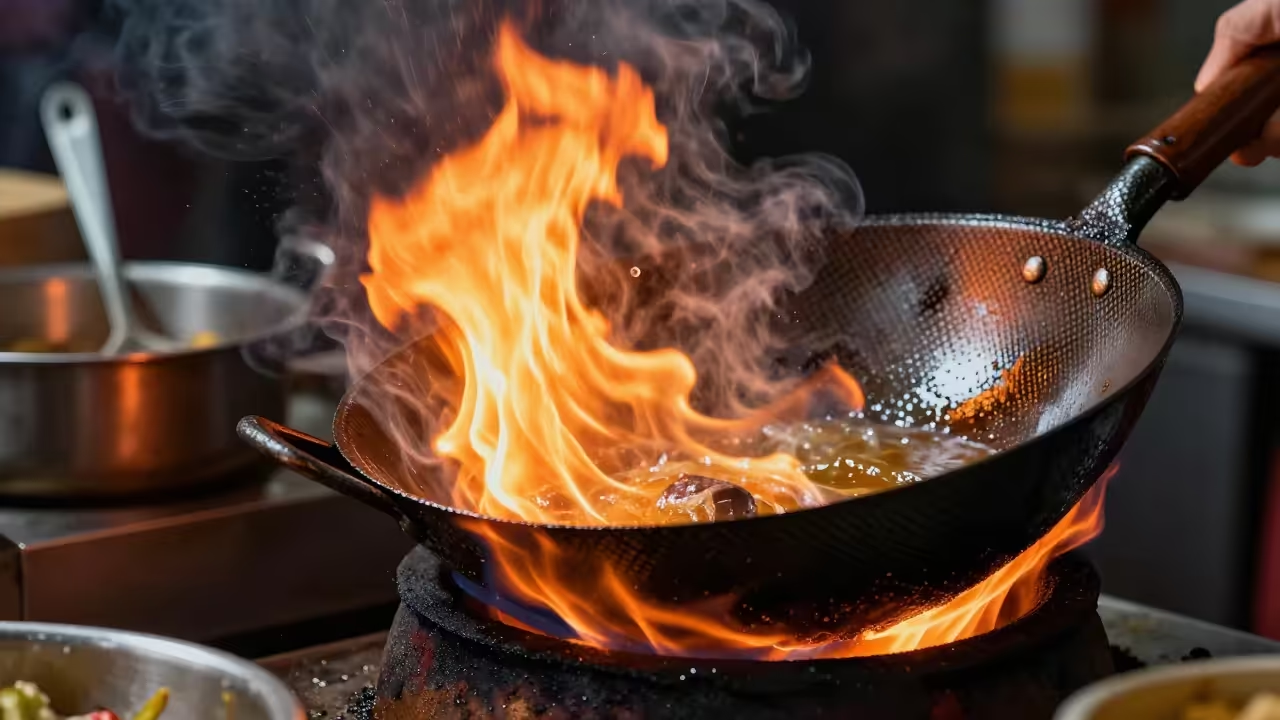
The carbon steel wok breath flare represents the pinnacle of street food thermal technique. This explosive moment occurs when superheated metal meets cold oil in a precisely controlled environment. The resulting ignition produces both visual drama and distinct acoustic signatures.
Professional chefs use this technique to achieve maximum wok hei in every dish. Wok hei translates to breath of the wok in Cantonese culinary tradition. This elusive quality emerges only when temperatures exceed four hundred fifty degrees Fahrenheit.
The Maillard reaction accelerates exponentially above three hundred ten degrees Fahrenheit. At breath flare temperatures, surface proteins caramelize within two seconds of contact.
Thermal Dynamics
The breath flare requires specific thermal conditions to execute safely and effectively. The wok must reach a uniform temperature across its entire cooking surface. Hot spots create dangerous flare ups that compromise food quality and safety.
A properly seasoned carbon steel wok distributes heat through its polymerized oil layers. The Leidenfrost effect governs the initial oil behavior during breath flare preparation. When the wok surface exceeds the Leidenfrost point for cooking oil, approximately six hundred degrees Fahrenheit, oil droplets levitate on a vapor cushion.
This vapor layer becomes the fuel source for the breath flare ignition. The levitation effect confirms the wok has reached the necessary thermal threshold for safe and effective breath flare execution.
Acoustic ASMR Properties
The breath flare produces a distinctive acoustic profile that qualifies as high fidelity culinary ASMR. The initial ignition crackle registers at approximately seventy five decibels. This frequency peaks between two thousand and four thousand hertz.
The sound resembles rapid percussion on a metallic surface. As the flame stabilizes, the acoustic signature shifts dramatically. The frequency drops to a sustained rumble between one hundred and three hundred hertz.
This low frequency vibration creates a visceral sensory experience for listeners. The continuous sizzling of oil vapor combustion provides white noise properties. Professional ASMR recording equipment captures these frequencies with exceptional clarity.
Contact microphones placed near the wok surface amplify the metallic resonance. The combination of high frequency crackle and low frequency rumble creates a complete sensory archive. These acoustic triggers justify the ASMR classification for wok cooking content.
Chef Detail One
The Maillard reaction threshold for most amino acids and reducing sugars occurs at three hundred ten degrees Fahrenheit. However, the reaction rate doubles for every eighteen degree Fahrenheit increase above this threshold. At breath flare temperatures of four hundred fifty degrees Fahrenheit, surface browning occurs in under three seconds.
This rapid reaction creates the characteristic dark crust and complex flavor compounds associated with wok hei. Understanding these thermal dynamics allows precise control over the cooking process.
Chef Detail Two
Moisture migration during breath flare cooking follows a precise thermal gradient. Surface moisture evaporates instantly at four hundred fifty degrees Fahrenheit, creating a vapor barrier. Internal moisture migrates outward through capillary action in the food matrix.
The sealed crust prevents excessive moisture loss while maintaining interior tenderness. This thermal differential produces the signature wok texture of crispy exterior and juicy interior.
Execution Protocol
- Begin by selecting a carbon steel wok with a thickness between two and three millimeters. Thinner woks heat faster but distribute heat less evenly. Thicker woks require longer preheating but maintain temperature stability better.
- Season the wok thoroughly with multiple layers of polymerized oil before attempting the breath flare technique. Preheat the wok over maximum flame for four to six minutes.
- The surface must reach a uniform temperature across the entire cooking area. Test the temperature by flicking a single drop of water onto the surface. The water should dance and levitate rather than sizzle and evaporate immediately.
- Add one to two tablespoons of high smoke point oil to the preheated wok. The oil should spread instantly and begin smoking within three seconds. Tilt the wok to coat the entire cooking surface with a thin oil film.
- Wait for the oil to reach its smoke point, approximately four hundred fifty degrees Fahrenheit. Introduce the flame source to ignite the oil vapor cloud. A long reach lighter or the existing burner flame can serve as the ignition source.
- The vapor cloud ignites in a ring pattern around the wok rim. The flame should rise two to four inches above the wok surface. This is the breath flare moment.
- Add ingredients immediately after the flame subsides to its sustained simmer phase. The residual heat sears proteins and vegetables within seconds. Toss continuously to ensure even cooking and prevent burning.
The entire cooking process should not exceed ninety seconds for most stir fry applications. Explore the full sensory archive at The Street & The Sizzle category for additional technical breakdowns and acoustic cooking content.
Ingredient Table
| Ingredient | Quantity | Purpose |
|---|---|---|
| High smoke point oil | 2 tablespoons | Breath flare fuel and cooking medium |
| Protein of choice | 8 ounces | Primary component for Maillard reaction |
| Aromatics | 3 cloves minced | Flavor foundation |
| Vegetables | 2 cups chopped | Texture and nutritional balance |
| Soy sauce | 2 tablespoons | Umami and salt |
| Sugar | 1 teaspoon | Caramelization enhancement |
| Cornstarch slurry | 2 tablespoons | Sauce thickening |
| Sesame oil | 1 teaspoon | Finishing aroma |
Equipment Table
| Equipment | Specification | Purpose |
|---|---|---|
| Carbon steel wok | 14 inch, 2.5mm thickness | Primary cooking vessel |
| High BTU burner | Minimum 40000 BTU | Achieve breath flare temperatures |
| Long reach lighter | 12 inch flame reach | Safe ignition source |
| Wok spatula | Carbon steel, angled edge | Ingredient tossing and stirring |
| Heat resistant gloves | Silicone coated | Wok handling safety |
| ASMR microphone | Contact type, 20kHz range | Acoustic capture |
| Infrared thermometer | 100 to 800 degrees Fahrenheit | Temperature verification |
Sensory Archive Conclusion
The carbon steel wok breath flare transcends simple cooking technique. It represents the intersection of thermal physics, acoustic engineering, and culinary artistry. The ASMR properties of the breath flare create a complete sensory experience for both practitioner and observer.
Master this technique to unlock the full potential of wok cooking. The high fidelity audio capture and visual documentation available in our sensory archive provide the reference material needed for successful execution.
🚀 Recommended Resources
Disclosure: Some of the links above are referral links. I may earn a commission if you make a purchase at no extra cost to you.