
The Failure of Monolithic Intelligence
Most AI engineers are currently hitting a wall with monolithic large language models. Massive context windows are failing due to severe attention dilution and semantic drift.
These systems simply guess the next token without any internal world model. This fundamental flaw leads to the hallucinations that plague modern enterprise deployments.
Disclaimer: I may earn a commission from purchases made through these links at no extra cost to you.


The solution is a shift toward predictive coding as the primary architectural direction. This approach replaces global gradients with hierarchical error correction loops.
The Mechanics of Prediction
Implementing this architecture feels like giving a machine a genuine sense of reality. You no longer fight against stochastic parrots that merely mimic patterns.
Instead you witness a system that actively minimizes surprise through internal state updates. It feels like the software is finally thinking instead of just calculating.
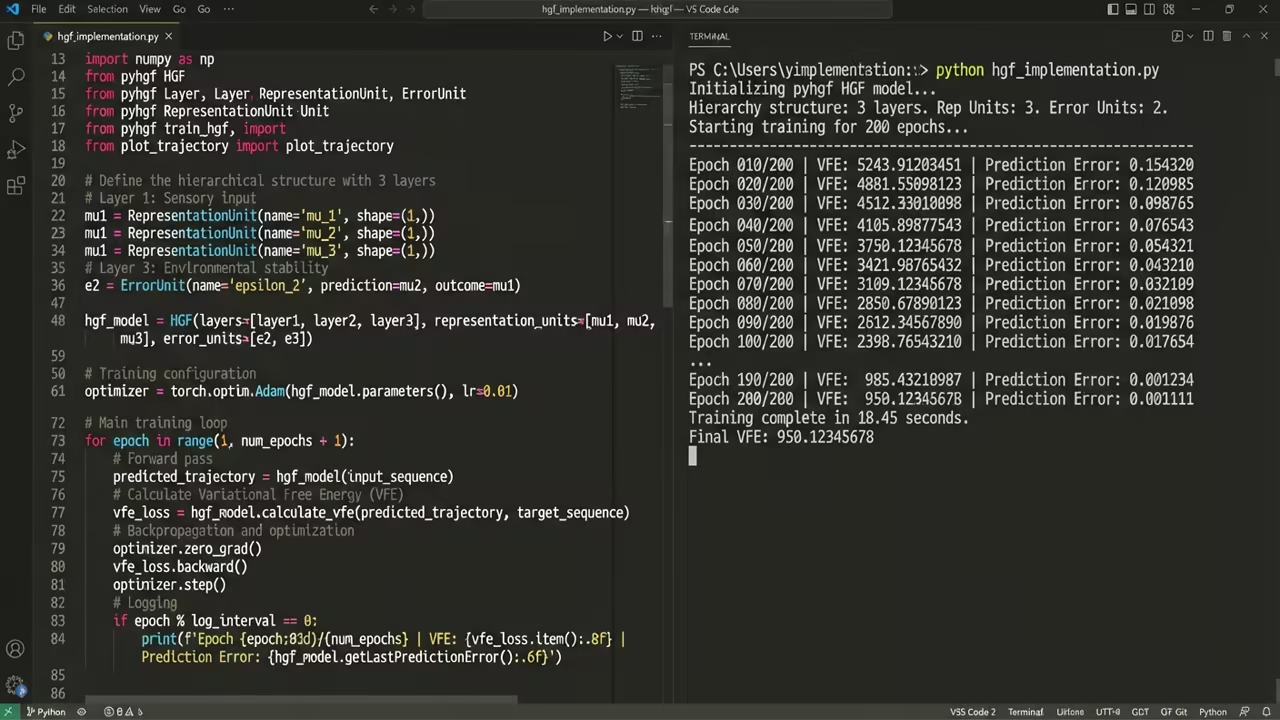
The core of this system relies on representation units and error units. Representation units hold the current hypothesis about the data.


Error units compute the residual difference between that hypothesis and actual input. This residual is then pushed upward to update higher level beliefs.
This creates a bidirectional flow of information that mimics biological neural processing. It is a far cry from the one way street of standard feedforward networks.
Moving Beyond the Global Gradient
Traditional deep learning depends on a global backward pass to update weights. This process is computationally expensive and biologically impossible.
Predictive coding uses local learning rules to update synaptic weights on the fly. This allows for arbitrary graph architectures and native feedback loops.
Active inference takes this further by treating perception as a form of planning. The agent acts to make the world match its internal predictions.
import pyhgf
import numpy as np
# Initialize a simple predictive coding hierarchy
# Layer 0 is sensory, Layer 1 is the representation layer
sensory_input = np.random.randn(10)
rep_unit = np.zeros(5)
weights_top_down = np.random.randn(5, 10)
def compute_prediction_error(input_data, hypothesis):
prediction = np.dot(hypothesis, weights_top_down)
return input_data - prediction
# Iterative error minimization
for epoch in range(100):
error = compute_prediction_error(sensory_input, rep_unit)
# Local update rule for representation units
rep_unit += 0.01 * np.dot(weights_top_down, error)
print(f"Final Prediction Error: {np.linalg.norm(error)}")
Solving the Scalability Wall
To master this stack you must solve the scalability wall in deep structures. Many networks suffer from error imbalance as they grow beyond seven layers.

An insider secret to fixing this is precision weighted latent optimization. You must dynamically scale the covariance of error distributions during the relaxation phase.
This prevents energy concentration in later layers and stabilizes the learning gradient. Without this optimization deep predictive networks often collapse into noise.
The Era of Harness Engineering
Integrating these systems requires moving from raw prompting to harness engineering. You need secure execution sandboxes and persistent memory file systems.
This allows domain specific language models to operate within strict boundary controls. These smaller nodes replace bloated general models in high stakes environments.
The result is a low latency system that maintains strict data privacy. It represents the next leap in autonomous agentic orchestration.
| Parameter | Traditional Deep Learning | Predictive Coding |
|---|---|---|
| Error Path | Global Backward Pass | Local Bidirectional Loops |
| Data Flow | Raw Activations | Residual Prediction Errors |
| Hardware | Power Hungry GPUs | Ultra Low Power Neuromorphic |
| Learning | Passive Loss Minimization | Active Free Energy Reduction |
The Future of Edge Native AI
This architectural breakthrough connects directly to previous deep dives on neuromorphic compute. It represents the final step in achieving true edge native AI.
You can now deploy these models on silicon without hitting the cloud. This removes the latency spikes that shatter enterprise service level objectives.
The transition to active inference is not just a trend. It is a necessary evolution for the future of autonomous intelligence.
Online Tutorials & Technical Help: https://ojambo.com/contact
Dive into our advanced architecture guides for more implementation secrets. Reach out for personalized technical help to scale your AI infrastructure.
🚀 Recommended Resources
Disclosure: Some of the links above are referral links. I may earn a commission if you make a purchase at no extra cost to you.