
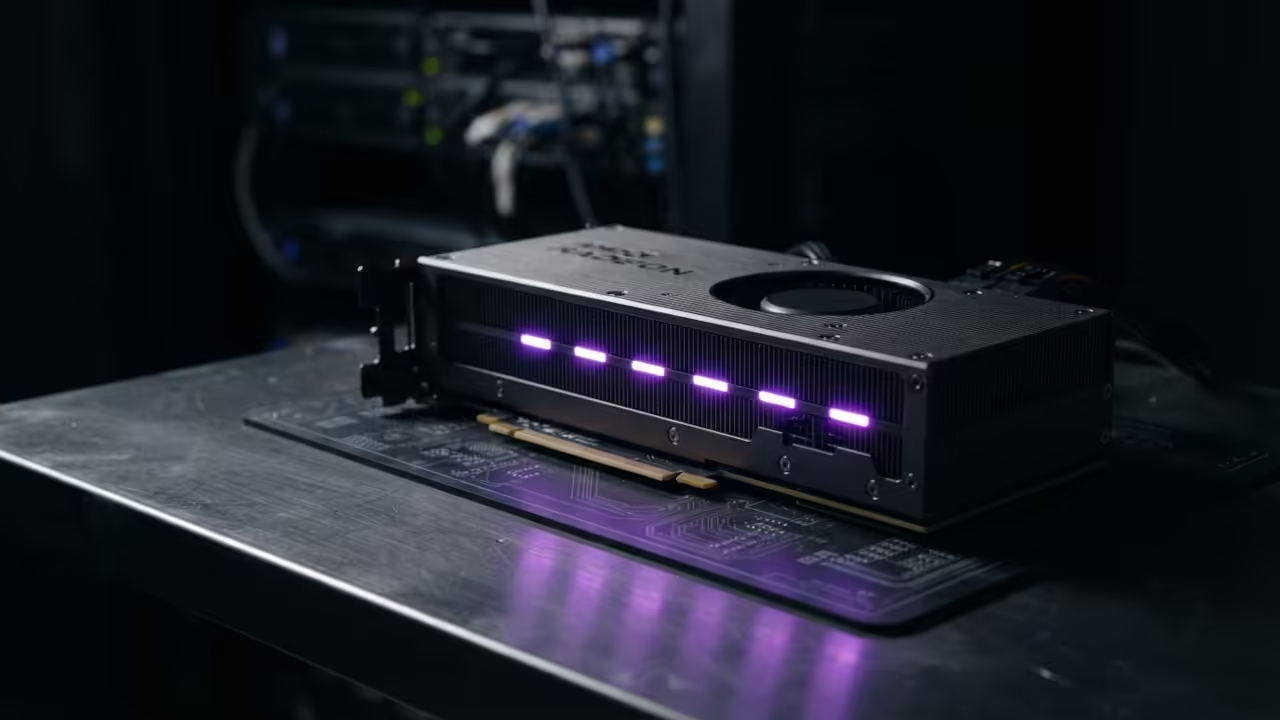
Local AI Video Generation With LingBot On AMD ROCm
Most video generation tools demand expensive cloud subscriptions or enterprise GPUs that cost more than a used car. The barrier to entry for local AI video creation has been impossibly high until now.
LingBot Video changes everything by delivering a fully open-source pipeline that runs on consumer AMD hardware with ROCm support. The LingBot Video Dense 1.3B model is the first open-source large-scale Mixture-of-Experts video generation model dedicated to embodied intelligence.
The Architecture Behind LingBot Video
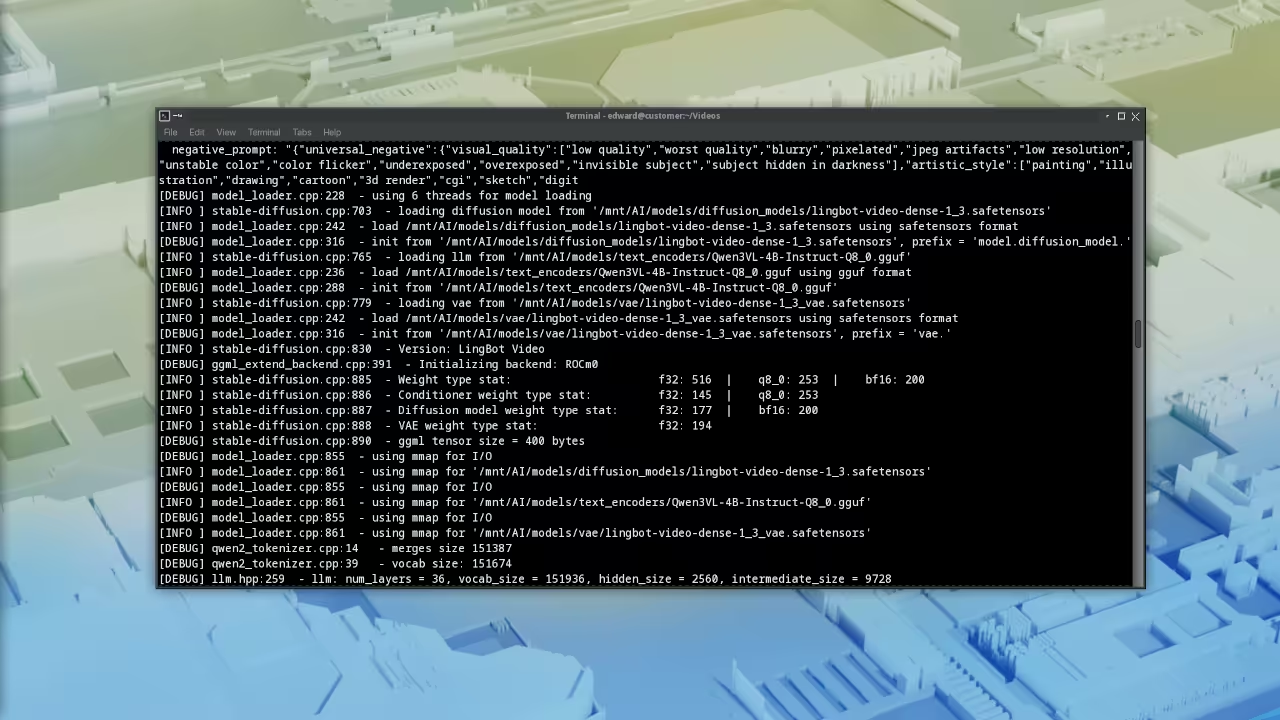
The model uses a LingBot Diffusion Transformer paired with the Wan 2.1 VAE and Qwen3-VL 4B as the LLM text encoder. The Dense 1.3B variant scales from scratch with balanced capacity and cost, delivering roughly three times faster inference than comparable models.
Here is the critical insider detail that the official documentation does not mention. The Wan 2.1 VAE listed in the stable-diffusion.cpp documentation did not work during testing. The VAE had to be downloaded directly from the LingBot HuggingFace site instead. This single fix resolved every generation failure encountered.
Qwen3-VL As The Text Encoder
The Qwen3-VL 4B Instruct model serves as both the text encoder and the prompt enhancer. It is available in GGUF format with multiple quantization levels including Q8_0 and Q4_K_M. The model supports native 256K context length and excels at structured JSON caption generation.
The Interleaved-MRoPE architecture provides full-frequency allocation over time, width, and height for robust positional embeddings. This matters enormously for video generation where temporal consistency is everything.
The Two-Stage Inference Workflow
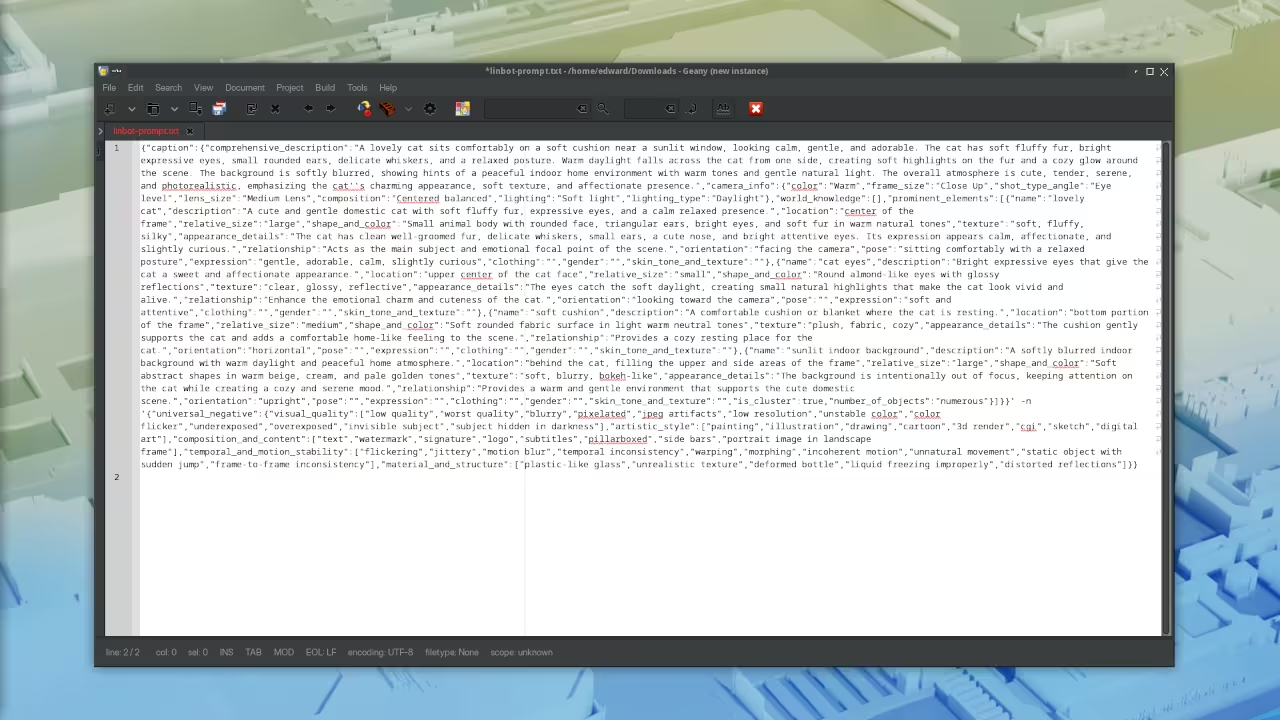
The inference workflow uses a two-stage semantic approach. First, the Qwen3-VL model rewrites your plain text prompt into a comprehensive structured JSON caption. This caption includes detailed scene descriptions, camera information, prominent elements with precise spatial relationships, and even texture and lighting specifications.
Second, the LingBot Diffusion Transformer consumes this structured JSON directly and generates the video frames. The result is dramatically more coherent than raw text prompts alone.
sd-cli sd-rocm -M vid_gen --diffusion-model /mnt/AI/models/diffusion_models/lingbot-video-dense-1_3.safetensors --vae /mnt/AI/models/vae/lingbot-video-dense-1_3_vae.safetensors --llm /mnt/AI/models/text_encoders/Qwen3VL-4B-Instruct-Q8_0.gguf --cfg-scale 3.0 --steps 20 --sampling-method euler -v -W 512 -H 256 --fps 4 --diffusion-fa --backend ROCm --params-backend disk --mmap --video-frames 25 --vae-tiling --temporal-tiling --extra-tiling-args "temporal_tile_frames=2,temporal_tile_overlap=1" --vae-tile-size 16x10 --vae-tile-overlap 0.125 -i input-image.webp -o output.webm -p 'structured-json-caption-here' -n 'negative-prompt-json-here'
Tiling And Memory Management
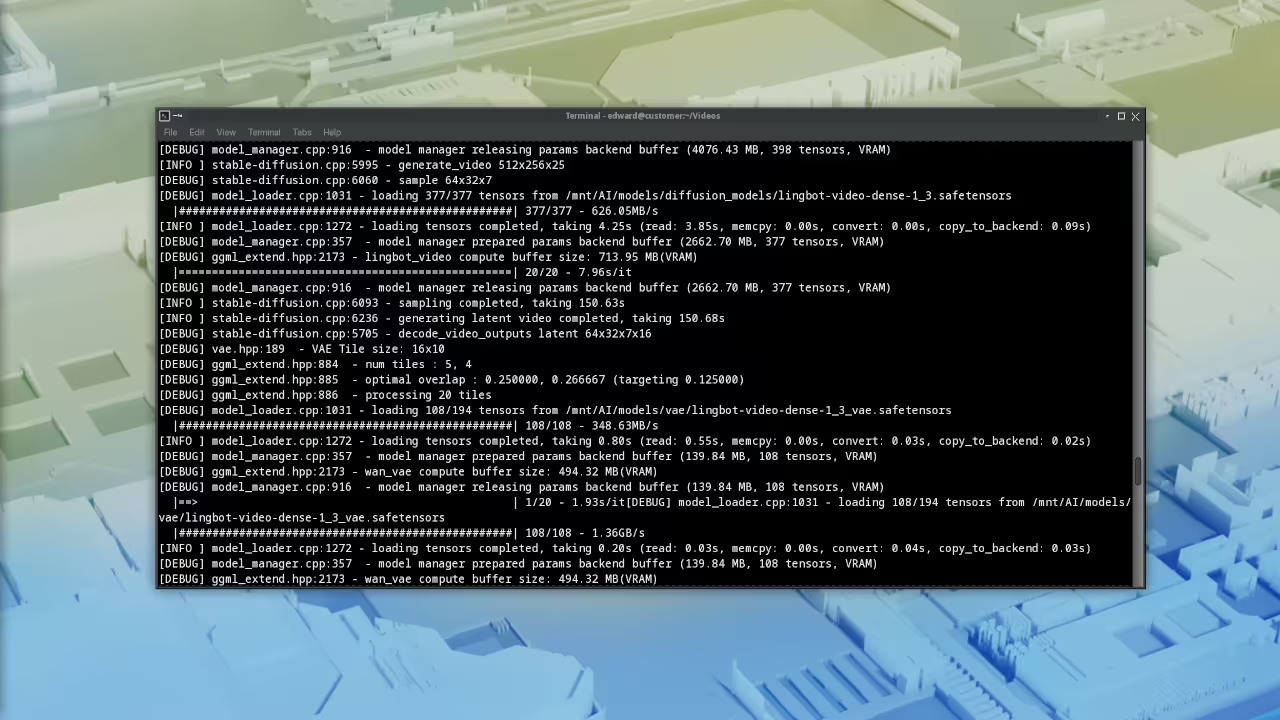
The tiling parameters are essential for systems with limited VRAM. The vae-tiling and temporal-tiling flags break the decoding process into manageable chunks. The extra-tiling-args parameter controls temporal tile frames and overlap, preventing frame-to-frame inconsistency during VAE decoding.
The params-backend disk flag with mmap reduces RAM pressure by memory-mapping model parameters instead of loading them entirely into system memory. Video frames should align with Wan-style temporal compression patterns. Use frame counts like 17, 25, 33, 49, or 81 for optimal results.
Model Component Comparison
| Component | Model | Format | Purpose |
|---|---|---|---|
| LingBot Dense | 1.3B parameters | safetensors | Diffusion Transformer for video generation |
| LingBot MoE | 30B-A3B + Refiner | safetensors | Mixture-of-Experts with refinement stage |
| Wan 2.1 VAE | LingBot variant | safetensors | Latent encoding and video decoding |
| Qwen3-VL 4B | Q8_0 or Q4_K_M | GGUF | Text encoder and prompt enhancer |
| Negative Prompt | Structured JSON | inline | Quality control and artifact prevention |
| Component | Model | Format | Purpose |
Structured JSON Caption Format
The structured JSON caption format is where this pipeline truly shines. Instead of writing a simple text prompt, you define the entire scene with precision. The caption includes a comprehensive description of the subject, camera information with color grading and lens specifications, prominent elements with exact locations and relative sizes, texture details, and even emotional expressions.
The negative prompt follows the same structured approach, targeting specific quality issues like flickering, warping, temporal inconsistency, and unwanted artistic styles. This level of control prevents the common failure modes of local video generation like frame-to-frame flickering, morphing artifacts, and unnatural movement patterns.
Performance On AMD Instinct MI60
The performance on an AMD Instinct MI60 is exceptional. With thirty-two gigabytes of VRAM, the Dense 1.3B model loads entirely on GPU with the ROCm backend. The diffusion-fa flag enables flash attention for faster cross-attention computation.
Generation of a twenty-five frame video at 512 by 256 resolution completes without thermal throttling or memory overflow. For creators working with limited storage, the Dense 1.3B variant requires significantly less disk space than the MoE 30B model. The Qwen3-VL GGUF files come in multiple quantization levels, allowing you to balance quality against storage constraints.
Production Workflow Enhancements
The LingBot Video ecosystem also includes a prompt rewriter built on Qwen3.6-27B that expands plain text prompts into the detailed JSON format automatically. This two-stage pipeline of rewriting followed by generation produces dramatically better results than manual prompt engineering alone.
For production workflows, deploying the VLM through an OpenAI-compatible API endpoint enables higher throughput than the single-process transformers backend. The model supports text-to-video, text-to-image, and image-to-video modes, each using different flags but sharing the same core architecture and model weights.
Master The Professional Stack
Every breakthrough in local AI video generation connects to deeper architectural principles that separate hobbyists from professionals. The blueprints below provide the complete foundation for building production-grade AI systems that scale from desktop experiments to enterprise deployments.
- Books (Technical and Creative): https://www.amazon.com/stores/Edward-Ojambo/author/B0D94QM76N
- Blueprints (DIY Woodworking Projects): https://ojamboshop.com
- Tutorials (Continuous Learning): https://ojambo.com/contact
- Consultations (Custom Apps and Architecture): https://ojamboservices.com/contact
🚀 Recommended Resources
Disclosure: Some of the links above are referral links. I may earn a commission if you make a purchase at no extra cost to you.