

The pivot toward isolated data ecosystems in 2026 has exposed the inherent fiscal fragility and regulatory exposure of legacy cloud-dependency models for modern digital firms. By architecting a localized 200TB TrueNAS SCALE infrastructure, enterprises reclaim their digital sovereignty while simultaneously triggering aggressive capital recovery mechanisms embedded within current North American tax legislation. This technical guide examines the intersection of elite ZFS file system management and strategic corporate tax planning, designed to transition IT overhead into a high-performance depreciable commodity.
TrueNAS SCALE 200TB Digital Sovereignty & Fiscal Compliance Framework
Critical metrics for your 2026 technical audit and IRS/CRA reporting requirements.
- ✓ Primary Tax Instrument: IRS Section 179 / CRA Class 50 (Accelerated)
- ✓ Deployment Window: 72-96 Hours (Validation & Burn-in included)
- ✓ Projected Annualized ROI: $30,375 (OpEx Savings + Capital Recovery)
Technical Specifications
The following hardware and software stack defines the 2026 gold standard for a resilient storage node, engineered for sustained 10GbE saturation and rigorous data compartmentalization.
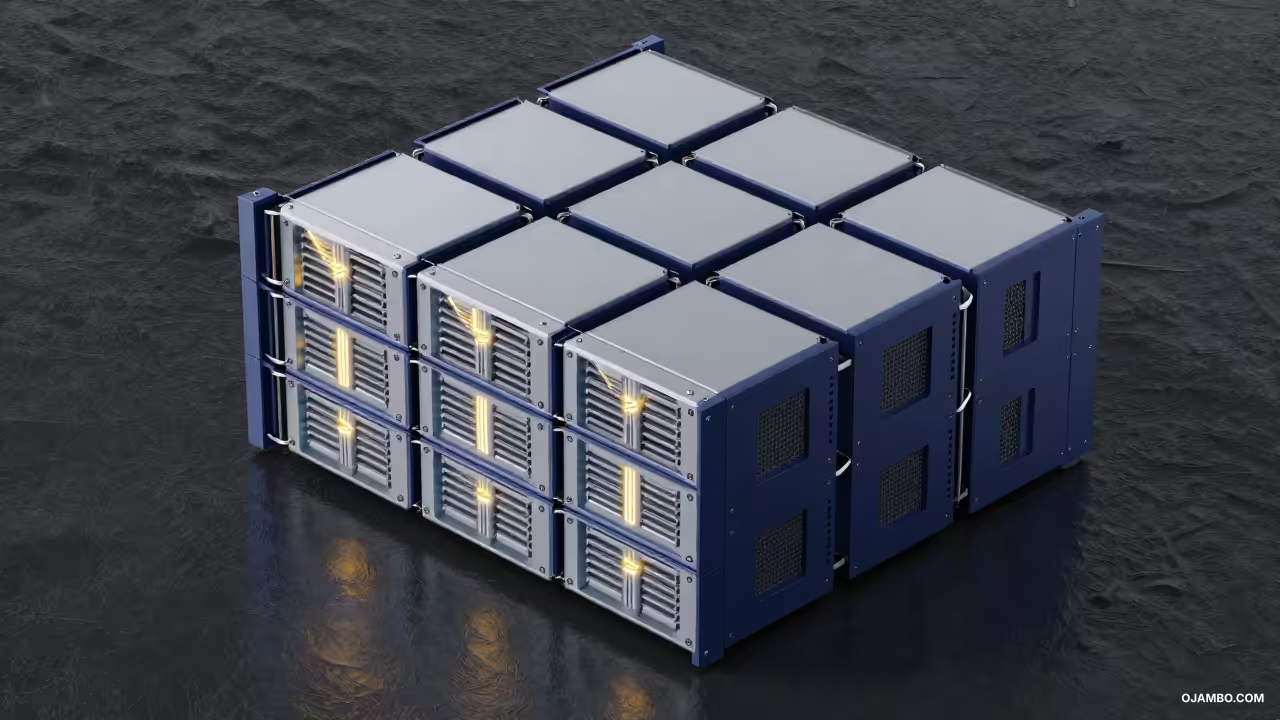
Hardware Profile: 12-Bay Rackmount Enclosure, Dual AMD EPYC 9004 Processors, 256GB ECC DDR5 Memory, 12x 22TB Enterprise-grade SAS HDD units. Software Environment: TrueNAS SCALE ElectricEel 24.10.x, OpenZFS 2.3, Docker Engine 27.x, KVM Hypervisor. Estimated Capital Investment: $18,500 – $24,000 USD (Subject to market fluctuations). Complexity Tier: Systems Architect / Principal Engineer.
Structural Architecture and Prerequisites
Engineering a 200TB environment in the 2026 landscape demands a precise equilibrium between gross storage volume and the IOPS overhead necessary for high-density containerized environments and AI-assisted data pipelines. We utilize the AMD EPYC 9004 platform specifically for its industry-leading PCIe 5.0 lane availability, a requirement for driving the Broadcom SAS 9600-16i HBA without bus saturation. This controller manages the 12x 22TB Western Digital Gold enterprise array, which we deploy in a RAID-Z3 configuration to provide a sophisticated triple-parity safety net against concurrent hardware failures.
Memory throughput remains the cornerstone of ZFS efficiency; the Adaptive Replacement Cache (ARC) performance is the primary determinant of latency in high-capacity pools. For a 200TB deployment, 256GB of ECC DDR5 is the baseline necessity to mitigate metadata congestion and maintain responsiveness during high-intensity scrub cycles. Network connectivity is facilitated by the Intel X710-DA2 dual-port 10GbE SFP+ NIC, ensuring the node can handle intensive replication demands and is prepared for future NVMe-over-Fabrics (NVMe-oF) transitions.
System integrity is anchored by the TrueNAS SCALE ElectricEel (24.10.x) release, offering a secure, Debian-hardened foundation for SaaS-Killer deployments. The adoption of OpenZFS 2.3 provides cutting-edge block-cloning capabilities and enhanced RAID-Z expansion logic, offering much higher flexibility than previous file system iterations. Security is reinforced via AES-256-GCM encryption at the dataset level, ensuring that data-at-rest remains impenetrable even if physical security is breached.
Data Flow and Logic
The internal logic of this 200TB node is managed by a multi-tiered storage strategy designed to protect data longevity while providing rapid access for active workloads. Write operations are initially ingested by the ZFS Intent Log (ZIL), with the option to leverage dedicated NVMe SLOG accelerators to minimize synchronous latency. Once committed to the 12-disk VDEV, OpenZFS utilizes its native copy-on-write architecture to eliminate the “write hole” and prevent data corruption during unforeseen power interruptions, maintaining a constant state of atomic consistency.
Ingress traffic is managed through redundant 10GbE paths, logically partitioned into isolated VLANs for management, storage protocols (iSCSI/NFS), and service data. This network segmentation is reinforced by a robust firewall matrix within TrueNAS SCALE, restricting service access to verified subnets. By deploying the integrated Docker engine, the infrastructure hosts sovereign alternatives to mainstream business tools, creating an autonomous ecosystem that removes the risks associated with third-party cloud providers. This “SaaS-Killer” approach consolidates management into a single, auditable administrative domain, maximizing performance while minimizing the external threat surface.
Deployment Roadmap
Step 1: Hardware Integration and Validation
Secure the 22TB enterprise drives within the chassis and verify full SAS pathing via the Broadcom 9600-16i HBA. Initiate a 72-hour burn-in phase using memtest86+ for memory validation and extensive badblocks cycles for the physical disks to flush out infant mortality hardware defects.
Step 2: OS Deployment and Network Hardening
Install the TrueNAS SCALE ElectricEel ISO onto redundant M.2 NVMe or SATA DOM boot media to eliminate single points of failure for the OS. Configure static IP addressing for the Intel X710-DA2 interfaces and establish LACP trunking if the network core supports high-bandwidth aggregation.
Step 3: ZFS Pool Orchestration
Provision the main storage pool using a 12-disk VDEV in RAID-Z3, optimizing for maximum fault tolerance. Adjust the recordsize to 1M for sequential media storage or 16K for high-transaction database workloads to refine the balance between IOPS and throughput.
Step 4: Encryption and Dataset Hierarchy
Develop a logical dataset structure that isolates administrative, media, and application data. Implement AES-256-GCM encryption at the root level and ensure that all recovery keys are stored in a secure, off-network hardware module or physical vault.
Step 5: Protocol Implementation (SMB/NFS/iSCSI)
Launch SMB shares for cross-platform client access with Active Directory hooks for granular permissioning. Deploy NFS and iSCSI targets for hypervisor clusters, ensuring that the “Sync Always” flag is set for mission-critical volumes to guarantee data persistence.
Step 6: SaaS-Killer Application Stack
Leverage the native Docker environment to deploy high-availability sovereignty applications like Nextcloud and Vaultwarden. Map persistent ZFS volumes to these containers, ensuring all application state data is captured by ZFS snapshots and replication policies.
Step 7: Automated Recovery and Snapshots
Establish a comprehensive snapshot rotation (daily, weekly, and monthly) to defend against ransomware and accidental data loss. Configure encrypted replication tasks to a secondary off-site TrueNAS unit or S3-compatible glacier storage to fulfill the 3-2-1 backup mandate.
Step 8: Security Audit and Logging
Deactivate unused services and relocate SSH/Web GUI access to non-standard ports to deter automated scanning. Enable S.M.A.R.T. telemetry alerts and export all audit logs to an external Syslog server for compliance verification.
Cloud Subscription vs. Sovereign Asset: 5-Year Outlook
Standard Enterprise Cloud (SaaS)
- Initial Cost: $0
- Yearly Subscription Fees: $33,600
- 5-Year Total Cost (TCO): $168,000
TrueNAS SCALE (Sovereign Node)
- Initial Capital Outlay: $22,500
- Yearly Operational Utility: $1,200
- 5-Year Total Cost (TCO): $28,500
2026 Fiscal Strategy and Tax Compliance
Architect’s Perspective: The 2026 fiscal environment offers a premier window for firms to aggressively depreciate high-density storage assets. Under IRS Section 179, American enterprises can often deduct the entire $22,500 purchase price in the first year, provided the node is operational by year-end. This front-loaded expense effectively subsidizes the migration to a digital sovereignty model, drastically lowering the net barrier to entry for enterprise hardware.
Canadian organizations benefit from Class 50 Capital Cost Allowance (CCA) for “General-Purpose Electronic Data Processing Equipment.” With its 55% declining balance rate, the majority of the 200TB node’s value is recoverable within 36 months. Furthermore, if the deployment supports internal R&D for data sovereignty or private AI modeling, associated labor costs may qualify for SR&ED tax credits, further augmenting the ROI of the “SaaS-Killer” transition.
Beyond the balance sheet, digital sovereignty is a critical compliance shield under 2026 data residency laws. By maintaining data on-premise via TrueNAS SCALE, firms bypass the legal ambiguities of the “Cloud Act” and ensure absolute jurisdictional control. This is vital for organizations managing sensitive EU data or operating in regulated environments like healthcare and finance, where third-party access to metadata is a significant liability.
Consult with a Principal Systems Architect
Deploying a TrueNAS SCALE 200TB Digital Sovereignty node requires a synthesis of high-level engineering and fiscal precision. I am available to lead your AMD EPYC deployment, optimize ZFS performance, and map your 2026 tax-compliance strategy for your enterprise.
Current Availability: Limited Q1/Q2 2026 engagements for ojambo.com partners.
Lifecycle Management and Expansion
Sustaining a 200TB footprint requires a proactive maintenance posture. Administrators must execute monthly ZFS “scrubs” to validate data integrity and preemptively address silent bit rot. All firmware updates for the HBA and enterprise drives should be validated in a staging environment prior to production rollout to prevent stability regressions.
Capacity expansion beyond 200TB is natively supported by TrueNAS SCALE, either through the “vdev expansion” feature matured in OpenZFS 2.3 or the addition of external JBOD shelves via the 9600-16i HBA. This modularity ensures that the initial capital investment remains productive and scalable well into the next decade, providing a future-proof foundation for evolving enterprise data requirements.
TrueNAS SCALE 200TB Digital Sovereignty & Fiscal Compliance Framework
Critical metrics for your 2026 technical audit and IRS/CRA reporting requirements.
- ✓ Primary Tax Instrument: IRS Section 179 / CRA Class 50 (Accelerated)
- ✓ Deployment Window: 72-96 Hours (Validation & Burn-in included)
- ✓ Projected Annualized ROI: $30,375 (OpEx Savings + Capital Recovery)
🚀 Recommended Resources
Disclosure: Some of the links above are referral links. I may earn a commission if you make a purchase at no extra cost to you.