
Streaming high definition video with less than half a second of delay remains the unreachable holy grail for most modern creators. Standard streaming protocols like HLS or DASH frequently introduce agonizing lag that kills real time audience interaction and professional remote collaboration.
Ant Media Server shatters these traditional limitations by leveraging enterprise grade WebRTC technology to deliver sub second latency across global networks. This architecture represents a massive shift for anyone running high impact interactive applications or private broadcasting infrastructure.
It transforms a standard server into a powerhouse capable of handling thousands of concurrent viewers without breaking a sweat. Once you deploy the environment on an AMD MI60 using the ROCm stack the performance gains become immediately apparent.
Unparalleled Real Time Experience
The interface feels incredibly snappy and the video ingestion remains rock solid even under heavy synthetic load tests. You finally experience the freedom of a broadcast system that responds as fast as a local local area network connection.
Seeing the millisecond counter sync perfectly between the source and the player provides a profound sense of technical mastery. It feels like stepping into the future of digital communication where distance no longer dictates the quality of the human experience.
Optimization and Hardware Integration
To achieve peak efficiency on high end hardware you must optimize the Java Virtual Machine heap settings and thread counts specifically for your CPU cores. One insider secret involves mapping the internal WebRTC ports directly to the physical hardware using the following command structure to bypass virtualized overhead.
sudo ./install_ant-media-server.sh -i true -s true
The system works best when you utilize hardware accelerated transcoding to offload the heavy lifting from your primary processor units. You should always verify that your Vulkan drivers are properly exposed to the Ant Media container to ensure seamless 4K stream processing.
Implementing a custom SSL certificate through the command line interface ensures that your browser based viewers maintain a secure and stable connection. Most users ignore the importance of tuning the UDP buffer sizes within the underlying kernel settings for high bitrate scenarios.
| Parameter | Ant Media Server | Standard HLS |
|---|---|---|
| Latency | Less than 0.5 Seconds | 10 to 30 Seconds |
| Protocol | WebRTC UDP | HTTP TCP |
| Scalability | Multi Node Cluster | CDN Dependent |
| Parameter | Ant Media Server | Standard HLS |

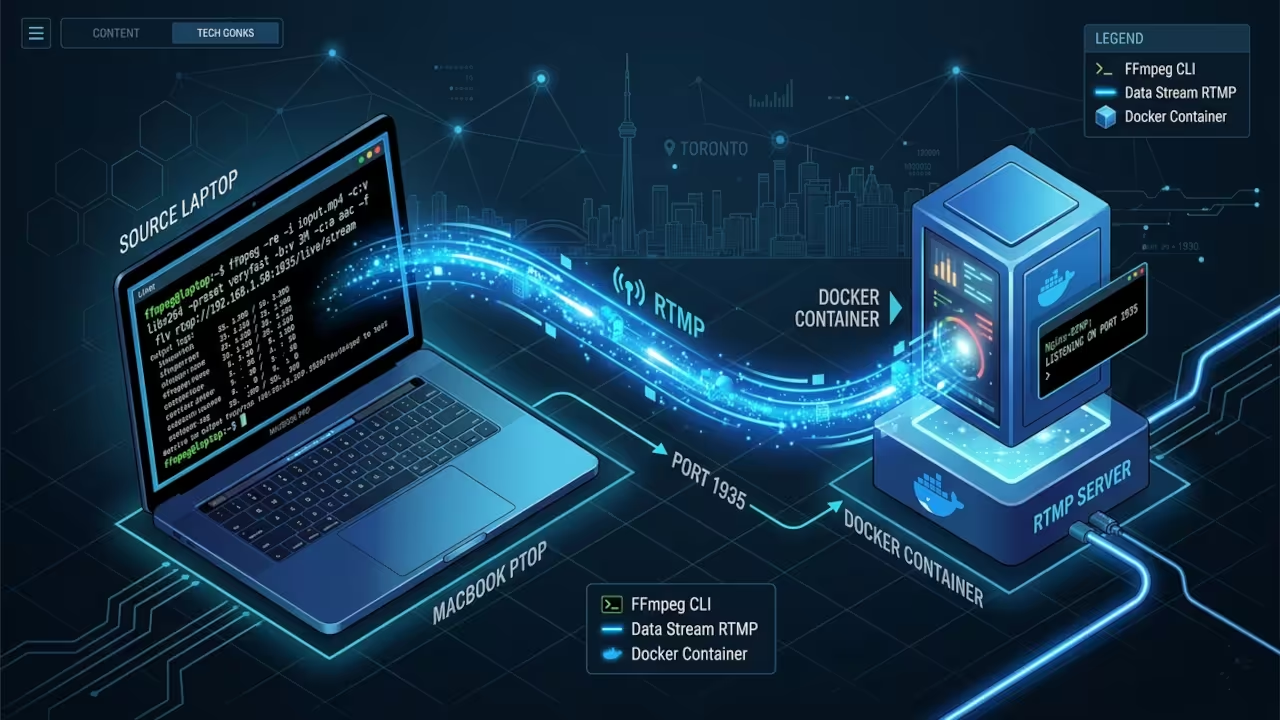
This specific WebRTC optimization acts as a critical bridge between our previous deep dives into edge computing and high performance media clusters. By mastering these low latency configurations you unlock the ability to build sophisticated telepresence robots and interactive gaming platforms that outperform commercial solutions.
Master the Professional Stack
Building a resilient streaming architecture requires a deep understanding of how hardware resources interact with modern containerized software deployments. These professional blueprints provide the exact technical roadmap needed to scale your infrastructure from a single node to a global cluster.
- Books (Technical Deep Dives): https://www.amazon.com/stores/Edward-Ojambo/author/B0D94QM76N
- Blueprints (DIY Woodworking Projects): https://ojamboshop.com
- Tutorials (Continuous Learning): https://ojamb.com/contact
- Consultations (Custom Architecture): https://ojamboservices.com/contact
🚀 Recommended Resources
Disclosure: Some of the links above are referral links. I may earn a commission if you make a purchase at no extra cost to you.