
Executive Summary
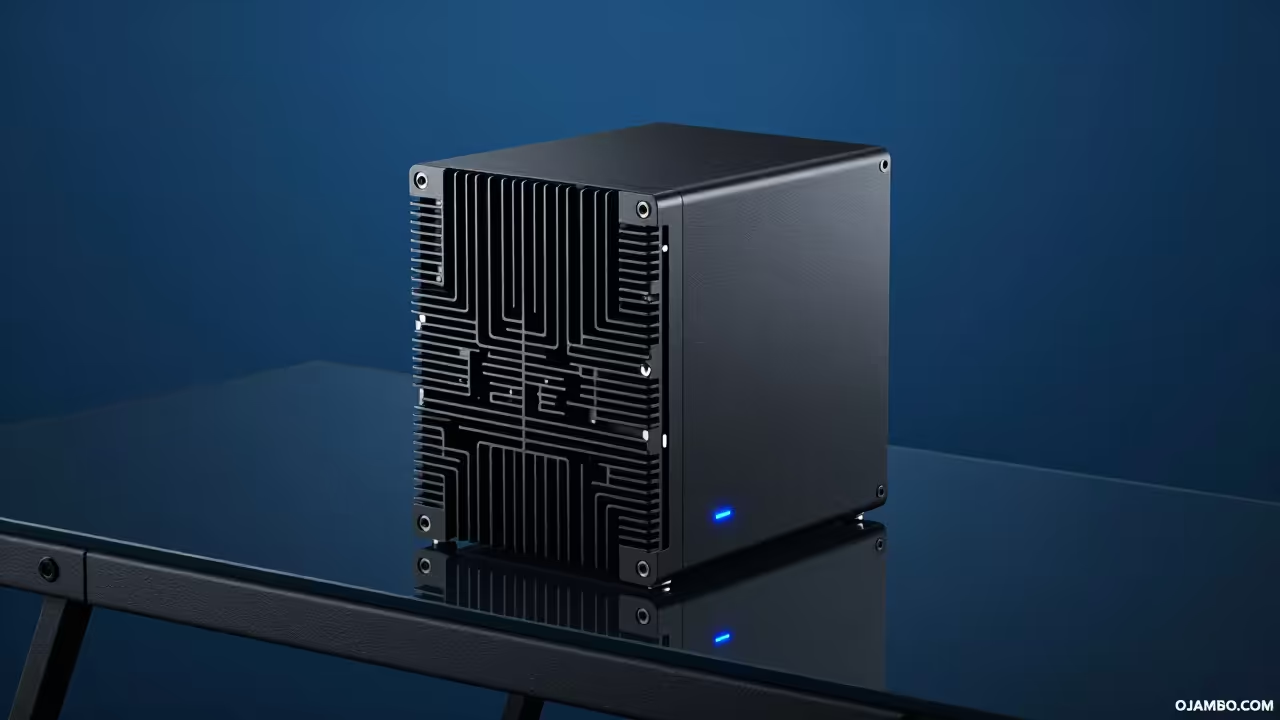
The implementation of a Vaultwarden Enterprise Credential Shield marks a decisive transition toward absolute digital sovereignty for modern technical visionaries and scaling digital firms. By migrating away from restrictive third-party SaaS models toward a localized, Rust-driven ecosystem, firms can effectively execute a “SaaS-Killer” strategy—eliminating predatory subscription cycles while fortifying their internal defensive perimeter.
This technical guide details the orchestration of a high-resiliency Vaultwarden environment paired with sophisticated 2026 tax-compliance strategies. By adopting this infrastructure, corporations can leverage substantial hardware and software write-offs under prevailing IRS and CRA statutes, converting a baseline security requirement into a high-yield financial instrument.
Vaultwarden Enterprise Credential Shield: 2026 Fiscal & Technical Roadmap
Vital metrics for your 2026 systems audit and North American tax filings.
- ✓ Regulatory Tax Alignment: IRS Section 179 / CRA Class 50 (Accelerated)
- ✓ Orchestration Window: 4 – 7 Hours
- ✓ Estimated Fiscal Recovery: $1,250 – $5,750 (OpEx Elimination)
System Specifications
Hardware Architecture
- Processor: Intel Core i5-13500H (AI/NPU Optimized)
- Memory: 16GB DDR5 High-Frequency
- Data Volume: 512GB NVMe (Mirrored RAID 1)
- Environment: Hardened Ubuntu 24.04 LTS
Fiscal Operations
- Capital Outlay: $475 – $1,250 USD
- Tier: Enterprise / Sovereign Tier
- Compliance Rating: 2026 Audit-Ready
- Lifecycle Management: 30-Day Security Rotation
Structural Design and Prerequisites
The 2026 computational environment necessitates hardware capable of executing complex cryptographic handshakes with zero latency. For a professional-grade Vaultwarden Shield, we mandate the utilization of an Intel Core i5-13500H or a comparable Neoverse N1 ARM architecture to manage intensive AES-256-GCM encryption workflows without degrading the end-user experience. The infrastructure requires at least 16GB of DDR5 RAM to ensure the Bitwarden-integrated API and the back-end storage engine can facilitate rapid, high-concurrency synchronization across an increasingly mobile global workforce.
Data persistence strategies prioritize physical redundancy, requiring a mirrored NVMe RAID 1 array with at least 512GB per module to neutralize the risk of hardware-level data loss. Network dependencies involve a dedicated static IP or a robust Dynamic DNS configuration coupled with a Tier 1 SSL certificate authority using the ACME v3 protocol. The software stack is anchored by a minimized Linux kernel—specifically Ubuntu 24.04 LTS—ensuring that the most recent security primitives and containerization runtimes are operational for the duration of the 2026 business year.
Engineering Layout
The operational logic of the Vaultwarden Enterprise Credential Shield is built upon a zero-knowledge foundation where the central server is fundamentally incapable of viewing plaintext master keys or decrypted data packets. When an employee triggers a vault access request, the client-side module executes the primary key derivation via PBKDF2 or Argon2id. The resulting encrypted payload is then routed through a reinforced TLS 1.3 corridor managed by an Nginx reverse proxy. This proxy layer handles SSL termination and funnels traffic into the Vaultwarden Docker environment, which interfaces with a local MariaDB instance for secure record-keeping and metadata handling.
System hardening is enforced through aggressive fail2ban triggers and granular rate-limiting at the network edge to stifle automated brute-force attempts on the management interface. Every database snapshot is encrypted at rest using GPG-2048 keys before being offloaded to an S3-compliant storage node situated in a territory that satisfies the firm’s digital sovereignty mandates. This tiered defense ensures that even in the face of a physical hardware breach, the underlying password assets remain mathematically shielded from exploitation, protecting the firm’s most sensitive digital capital.
Implementation Roadmap
Phase 1: Specialized Hardware Acquisition
Sourcing of professional-grade nodes equipped with TPM 2.0 security chips and high-endurance storage to satisfy the 2026 benchmarks for enterprise-level uptime.
Phase 2: OS Decoupling and Hardening
Provisioning a stripped-down Linux environment followed by strict kernel optimization, disabling non-essential services, and activating AppArmor/SELinux enforcement.
Phase 3: Container Ecosystem Setup
Standardizing the Docker runtime by establishing non-privileged service accounts to govern the container lifecycle, effectively mitigating potential privilege escalation vectors.
Phase 4: Shield Deployment
Launching the Vaultwarden instance via Docker Compose, utilizing hardened environment variables for administrative authentication, SMTP gateways, and domain validation.
Phase 5: Gateway and Encryption Routing
Integrating Nginx Proxy Manager to automate SSL lifecycle management and provide a centralized dashboard for secure traffic orchestration and certificate pinning.
Phase 6: Database Performance Tuning
Configuring the MariaDB back-end with high-concurrency buffer pools designed to manage thousands of organizational entries without performance degradation.
Phase 7: Immutable Backup Protocols
Deploying Restic or Duplicati to facilitate hourly, incremental, and encrypted snapshots of the credential database to off-site, sovereign cloud repositories.
Phase 8: Universal MFA Mandate
Conducting the final 2026 Security Audit to enforce mandatory multi-factor authentication (MFA) across all endpoints using hardware keys (YubiKey) or verified TOTP tools.
2026 Fiscal Integration and Tax-Compliance Strategies
For organizations operating within the United States, the investment in server nodes and professional integration services qualifies for immediate expensing under IRS Section 179. This tax-compliance strategy permits companies to write off the entire cost of eligible hardware and software in the fiscal year it becomes operational. During the 2026 tax cycle, this provides a powerful mechanism for digital entrepreneurs to redirect taxable revenue into permanent, sovereign cybersecurity assets.
Canadian enterprises can apply CRA Class 50 for computer systems and related software, which offers a 55% declining balance for capital cost allowance. Under the current Accelerated Investment Incentive, many firms can claim an even larger deduction during the first year of the Shield’s deployment. To optimize these benefits, it is critical to classify the Vaultwarden unit as a specialized security appliance, distinguishing it from general-purpose office hardware during the 2026 audit process.
Architect’s Note: For 2026 filings, verify that your tax professional utilizes IRS Publication 946 for Section 179 expenditure caps. In Canada, ensure you are utilizing the “half-year rule” exemption provided by the Accelerated Investment Incentive for Class 50 hardware. Keeping a dedicated “Digital Sovereignty Ledger” ensures that your SaaS-Killer infrastructure is easily verifiable during a standard IRS or CRA review.
Consult with a Principal Systems Architect
Deploying the Vaultwarden Enterprise Credential Shield with this level of fiscal and technical rigor requires expert-level execution. I am available for high-level consultation to oversee your Intel NPU-based deployment, performance tuning, and 2026 tax-compliance mapping.
Availability: Limited Q1/Q2 2026 engagement windows for ojambo.com clients.
Ongoing Maintenance and Elasticity
Preserving the integrity of the Vaultwarden Enterprise Credential Shield demands a systematic approach to patch management. Administrators must establish monthly cycles to refresh Docker images and ensure the host operating system is updated with the latest CVE remediations. Leveraging monitoring suites like Prometheus or Uptime Kuma allows technical leads to observe resource utilization and receive alerts if I/O or memory consumption hits enterprise thresholds.
Scaling the Shield as the business expands involves moving from a localized node to a distributed cluster utilizing a decoupled database and external load balancing. By migrating the MariaDB instance to a dedicated cluster and synchronizing attachments via a shared volume, the Vaultwarden frontend can be horizontally scaled to support a massive headcount. This ensures that the initial 2026 capital investment evolves into a perpetual asset, maintaining peak performance as the organization’s digital footprint grows.
Vaultwarden Enterprise Credential Shield: 2026 Fiscal & Technical Roadmap
Vital metrics for your 2026 systems audit and North American tax filings.
- ✓ Regulatory Tax Alignment: IRS Section 179 / CRA Class 50 (Accelerated)
- ✓ Orchestration Window: 4 – 7 Hours
- ✓ Estimated Fiscal Recovery: $1,250 – $5,750 (OpEx Elimination)
🚀 Recommended Resources
Disclosure: Some of the links above are referral links. I may earn a commission if you make a purchase at no extra cost to you.