

The GPU price ceiling is crushing innovation, forcing creative professionals into debilitating budget compromises every single quarter. We constantly face a false choice between proprietary walled garden ecosystems and wildly underperforming commodity hardware solutions. This systemic financial constraint stifles truly bleeding edge technical development across AI and creative pipelines.
The industry has long relied on a few dominant, hyper priced silicon solutions that dictate market rates. However, the rise of architectures like the AMD MI60 presents a seismic shift in the computational landscape. We are witnessing the democratization of extreme performance through open source stacks and specialized hardware.
Rethinking High Performance Computing
This is not merely a hardware comparison; it is a philosophical divergence on how high performance computing should be accessible globally. The MI60, when correctly married to a robust ROCm environment, bypasses many of the traditional performance and cost bottlenecks. This architecture fundamentally redefines what constitutes a viable, high throughput workstation.
Imagine the sheer exhilaration of seeing complex diffusion models train in fractions of the expected time. Picture the relief of achieving industry leading speeds without sinking thousands into a single monolithic GPU purchase. That feeling, the successful harnessing of raw efficient power, is the ultimate professional reward.
Experience Unlocked: The Open Source Advantage
The technical barrier, however, requires specific architectural knowledge to overcome successfully. Simply plugging in the MI60 is not enough to unlock its true potential and superior computational density. You must understand how the underlying kernels interact with the ROCm library.
The foundational software stack demands precision, much like the intricate mechanical blueprints we detailed in our previous architectural breakthroughs on distributed rendering nodes. Mastering this layer ensures you are driving the hardware, not merely running on it.
Insider Technical Deep Dive: Kernel Optimization
A crucial insider detail involves the utilization of specific environmental variables before any large scale training run. Setting the correct memory allocation parameters prevents common kernel overruns that severely throttle real world throughput. This small configuration tweak can yield significant gains in sustained performance, especially on large batch jobs.
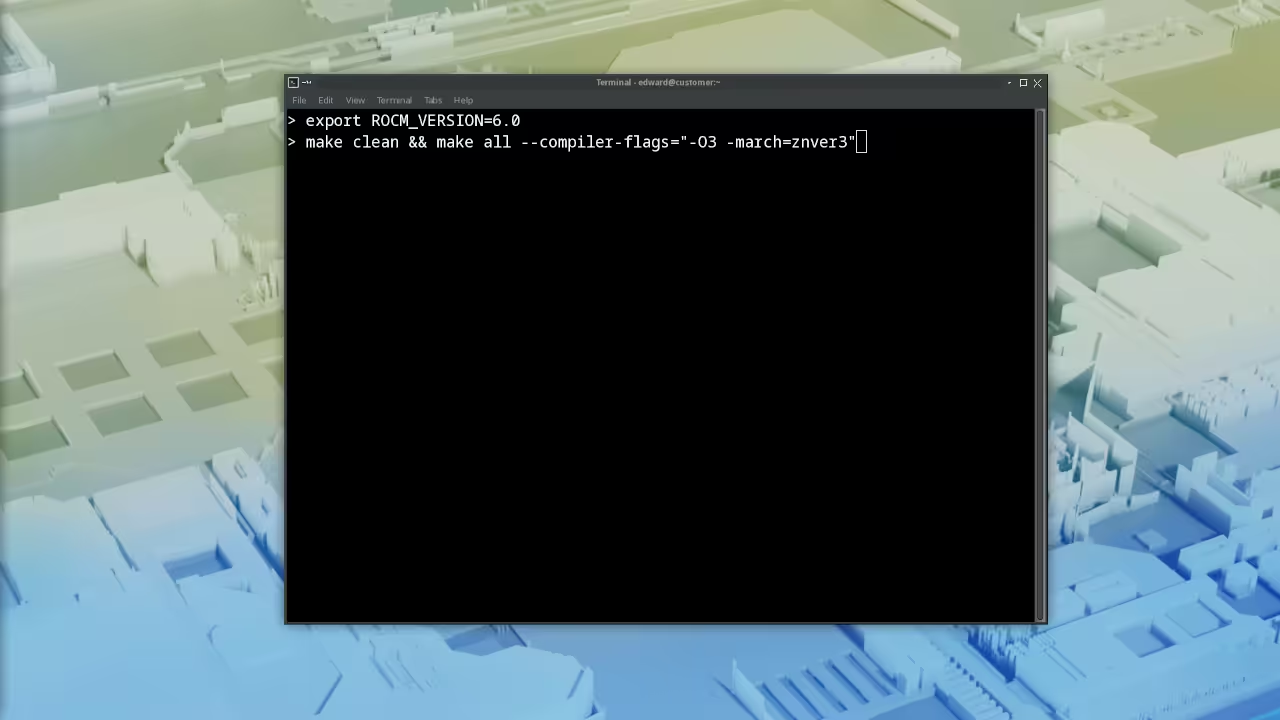
To start leveraging this performance leap, your initial steps involve setting up the environment correctly. You will need to ensure your system compiler matches the expected API version.
export ROCM_VERSION="6.0"
make clean && make all --compiler-flags="-O3 -march=znver3"
| Hardware | Pricing Model | Ecosystem | Compute Focus |
|---|---|---|---|
| Nvidia Flagship GPU | High Price Point | Proprietary Software Lock | Consumer Focused Features |
| AMD MI60 | Significantly Lower | Open Source (ROCm/Vulkan) | Data Center Compute Focused |
| Scalability | Limited | Highly Scalable Cluster Ready | Massive Parallel Processing |
Master the Professional Stack and Architect Your Future
The shift to ROCm requires a mindset shift from consumer grade graphical rendering to pure, raw parallel computation. This is where the true power of the open source community shines brightest. We are building a truly decentralized future for high performance creative work.
By mastering the unique architectural demands of the MI60 within the open source framework, you gain access to specialized technical insights that transcend mere hardware specs. These principles are foundational to the high level architectural blueprints detailed in the collection below.
- Books (Technical & Creative): View Technical & Creative Blueprints
- Blueprints (DIY Woodworking Projects): Explore DIY Plans
- Tutorials (Continuous Learning): Access Continuous Learning Tutorials
- Consultations (Custom Apps & Architecture): Book Senior Architect Consultations

Conclusion: The Path to Technical Independence
This deep dive serves as a critical junction point, demonstrating why a holistic understanding of system architecture is mandatory. It connects directly to the challenges of designing robust, scalable cloud native solutions we previously covered.
The MI60 represents a massive opportunity for technically adept enthusiasts and professionals alike. It is an invitation to transcend the limitations imposed by incumbent hardware monopolies. Dive into the documentation and start building your own high performance ecosystem today.
🚀 Recommended Resources
Disclosure: Some of the links above are referral links. I may earn a commission if you make a purchase at no extra cost to you.