
Blog

  • B.C. family benefit

    B.C. family benefit


    Understanding the B.C. Family Benefit

    The B.C. family benefit is a regional financial program providing tax-free monthly installments to residents raising children under 18. While funded by the Province of British Columbia, the Canada Revenue Agency (CRA) handles the distribution, often merging it with the federal Canada Child Benefit (CCB) for a streamlined single payment.

    Looking ahead to July 2027, the provincial government plans to integrate a new disability supplement. This expansion targets families supporting children with significant physical or mental impairments, aligning with the inclusive goals of Bill C-22 to provide deeper financial cushions for vulnerable households.

    2026 Technical Breakdown

    Category 2025-2026 Fiscal Details
    Management Authority Canada Revenue Agency (CRA)
    Disbursement Cycle Monthly (Integrated with CCB)
    Primary Child Max $1,750 annually
    Secondary Child Max $1,100 annually
    Successive Children $900 per child annually
    Base Income Limit Adjusted Family Net Income < $29,526
    Lone Parent Add-on Up to $500 per household
    Regulatory Code B.C. Income Tax Act Section 13.092

    Core Eligibility

    Designed to mitigate the rising costs of childcare, the benefit relies on annual tax data to determine eligibility. Most families already enrolled in federal programs will find their provincial credits applied automatically each month without needing a separate application.

    Enrollment Process

    To ensure you receive these funds, both you and your partner must file your annual T1 Income Tax and Benefit Returns. Families already receiving the CCB are grandfathered into the provincial system automatically.

    New arrivals to British Columbia or those with unregistered children must apply through the CRA. It is vital to maintain updated residency records; moving out of the province requires immediate notification to prevent overpayment issues or debt recovery actions.

    Projected Benefit Tiers

    Following the conclusion of temporary subsidies in mid-2025, the benefit has returned to its standard legislative rates for the 2025-2026 cycle:

    • First Child: $1,750 per year
    • Second Child: $1,100 per year
    • Each Additional Child: $900 per year

    Full amounts are granted to families with a 2024 net income below $29,526. For those earning between $29,526 and $94,483, guaranteed minimums apply ($775 for the first child, $750 for the second). Incomes exceeding $94,483 see a gradual reduction of 4% until the credit is phased out.

    Single Parent Considerations

    Single parents with lower incomes may receive an extra $500 yearly supplement. Eligibility hinges on receiving the monthly B.C. family benefit and maintaining a non-cohabitating status. This supplement scales down alongside the primary benefit as income rises above the base threshold.

    Calculating Payments

    Your monthly check is calculated by dividing your total annual entitlement by twelve. In shared-custody arrangements, payments are split 50/50 between guardians, following standard CRA protocols.

    Compliance and Updates

    To keep your benefits active and accurate, you must inform the CRA of life changes, including residential moves, marital status shifts, or changes in the number of dependents. For direct inquiries, the CRA can be reached at 1-800-387-1193.

  • Ontario Trillium Benefit Questions and Answers

    Ontario Trillium Benefit Questions and Answers

    The Ontario Trillium Benefit (OTB) acts as a vital financial resource for residents, merging three distinct provincial tax credits into one monthly or annual disbursement managed by the Canada Revenue Agency (CRA). This initiative combines the Ontario Sales Tax Credit (OSTC), the Northern Ontario Energy Credit (NOEC), and the Ontario Energy and Property Tax Credit (OEPTC) to provide efficient relief to households.

    Eligibility for the 2026 cycle is calculated based on information provided in your 2025 tax filing. Grasping the specific payment windows, the option for a year-end lump sum, and the filing requirements is key to ensuring you receive your full entitlement under current provincial regulations.

    Overview: 2026 OTB Framework

    Category Details
    Benefit Period July 2026 through June 2027
    Reference Year 2025 Income Tax Return
    Administrator CRA (on behalf of Ontario)
    Distribution Monthly (10th day) or Annual Total
    Minimum Cut-off No payout for totals under $2
    Automatic Lump Sum Totals of $360 or less are paid in July 2026
    Taxability Tax-exempt income

    1. Defining the Ontario Trillium Benefit

    The OTB aggregates the Ontario energy and property tax credit, the Northern Ontario energy credit, and the Ontario sales tax credit. Typically, the total annual amount is divided into 12 parts and distributed on the 10th of every month.

    Based on your 2025 tax data, 2026 OTB installments run from July 2026 to June 2027. If the 10th falls on a holiday or weekend, the funds are usually deposited on the preceding business day.

    2. Qualifying for the OTB

    To qualify, you must be eligible for at least one of the three underlying credits. Core requirements include living in Ontario on the first day of the payment month and filing a 2025 return—even if you have no income to report for that year.

    3. Receiving Partial Components

    Yes, you do not need to qualify for all three credits. The CRA will calculate your total benefit based on whichever specific components (OEPTC, NOEC, or OSTC) apply to your situation.

    4. How to Apply for 2026 Benefits

    Filing your 2025 income tax and benefit return is the primary requirement for the 2026 OTB.

    While the OSTC is automatically assessed by the CRA, you must actively apply for the OEPTC and NOEC by filling out Form ON‑BEN (Application for the 2026 Ontario Trillium Benefit) and submitting it with your tax return.

    In the case of couples, the OSTC is issued to the individual whose return is processed first. If one partner is a senior (64+ by the end of 2025), they should handle the application for the property and energy credits for the household.

    5. Disbursement Timeline

    If the CRA assesses your 2025 return by June 19, 2026, your first installment should arrive on July 10, 2026.

    Delayed filings generally see payments start 4 to 8 weeks after assessment. If your total annual benefit is $360 or less, it is issued as a single payment in your first eligible month (usually July).

    6. Calculation of Amounts

    Total amounts vary based on adjusted family net income, age, geographical location in Ontario, and the specific costs paid for property taxes or rent.

    7. Payment Authority

    The Canada Revenue Agency handles the distribution of these provincial funds.

    8. Receiving Your Funds

    The CRA uses direct deposit for those registered; otherwise, a paper cheque is sent via mail.

    9. Choosing a Single Annual Payment

    If your 2026 entitlement exceeds $360, you have the option to receive a single lump sum in June 2027 instead of monthly payments.

    To elect this, check box 61060 on Form ON‑BEN. This election must be renewed every year. For amounts $360 or under, a single July payment is mandatory.

    10. Reversing the Lump-Sum Choice

    You can switch back to monthly payments by calling 1-877-627-6645. Once updated, you will receive a catch-up payment and resume monthly installments.

    11. Revocation of Single Payment Election

    The CRA will cancel a single-payment choice if you leave Ontario, file for bankruptcy, or are in prison for more than 90 days. In these instances, any accrued funds will be paid out as applicable.

    12. Election Deadlines

    The choice for a single payment should be made at the time of filing. However, you can make this election up until December 31, 2026, if your return hasn’t been processed yet.

    13. Understanding Early Lump Sums

    Small entitlements (under $360) are paid upfront in July to reduce administrative costs, rather than being spread across twelve tiny payments.

    14. Minimum Payment Rule

    Amounts of $2 or less are not paid. Totals between $2 and $10 are increased to a flat $10 payout.

    15. Impact of Not Filing

    Filing is essential. Without a submitted 2025 tax return, the CRA cannot determine your eligibility or issue any OTB funds.

    16. Discrepancies on Tax Forms

    Your tax software may not show the OTB total because it is a provincial program calculated separately from federal taxes based on the ON-BEN form data.

    17. Separate Spousal Applications

    Couples must apply together for the energy and property credits. One spouse applies for the family, and the CRA manages the distribution accordingly.

    18. Address Updates

    Moving may change your eligibility (especially for the Northern Ontario credit). Notify the CRA via My Account or at 1-877-627-6645 immediately.

    19. Debts and Offsets

    The CRA may use OTB funds to pay down existing government debts or overdue family support payments before issuing any remaining balance to you.

    20. Tax Implications

    The OTB is completely tax-free. You do not list it as income on your tax returns.

    21. Interest Policies

    The government does not pay interest on delayed OTB funds, nor is interest charged if you are required to repay an overpayment.

    22. Back-filing for Missed Years

    You can claim missed OTB benefits for up to 10 years by requesting a tax adjustment through Form T1-ADJ or the CRA’s digital portal.

    23. Eligibility in the Year of Death

    If a person passes away before July 1, 2026, the estate cannot claim the 2026 benefit. If death occurs after that date, the estate receives payments only for the months the individual was alive.

    24. Overpayments to Estates

    Any OTB payments received for months after a recipient’s death must be returned to the CRA with documentation.

    25. Policy Inquiries

    For questions about the provincial policies behind these credits, contact the Ontario government at 1-866-ONT-TAXS (1-866-668-8297).

  • Canada Groceries and Essentials Benefit GST HST credit

    Canada Groceries and Essentials Benefit GST HST credit

    The GST/HST credit serves as a non-taxable quarterly disbursement intended to support individuals and families with modest earnings. This financial aid effectively helps neutralize the impact of sales taxes paid on everyday expenses throughout the calendar year.

    For the 2026 fiscal year, the Canadian government has implemented a major programmatic shift. Reintroduced as the Canada Groceries and Essentials Benefit, this initiative includes a 25% hike in base payment rates, guaranteed for a five-year window beginning July 2026.

    Additionally, those who qualified for the January 2026 credit cycle are eligible for a single supplemental top-up. This specific payment grants half the total value of the 2025-26 benefit year and is slated for distribution by June 2026 at the latest.

    Eligibility is determined automatically through the submission of a yearly income tax return. As long as Canadian residents file on time, no further application steps are necessary.

    Program Breakdown

    Benefit Feature 2026 Timeline Frequency 2026 Adjustment
    Supplemental Top-Up Jan 2026 Recipients One-time (June 2026) 50% of 2025-26 Rate
    Standard Credit Quarterly Intervals Ongoing 25% Raise effective July
    Regional Add-ons Per Province/Territory Integrated Active
    Tax Obligation Exempt Tax-Free Confirmed

    Qualifying Criteria

    To receive the Canada Groceries and Essentials Benefit, you must maintain residency in Canada for tax purposes at the start of the month when a payment is issued.

    Furthermore, you must meet at least one of these conditions:

    * You have reached 19 years of age.
    * You currently have, or previously had, a spouse or common-law partner.
    * You are, or were, a parent residing with your child.

    Income Caps and Custody Rules

    Your total adjusted family net income dictates your entitlement. If your earnings surpass the 2026 thresholds set by the CRA, you will not qualify. In shared custody arrangements, the credit is split, with each parent receiving 50% of the applicable amount.

    Calculation of Benefits

    The total funds you receive are based on your 2025 tax filing for the cycle starting July 2026. The CRA applies a calculation that considers your marital status and any children enrolled in the Canada Child Benefit (CCB).

    Personalized payment details are accessible via the CRA My Account digital portal. Due to the 25% permanent increase, the 2026 fiscal period will provide notably higher quarterly sums than previous years.

    Newcomers to Canada are required to submit Form RC66 or Form RC151 to establish their eligibility, as the CRA lacks the historical tax data needed for automatic processing.

    Relevant Payment Dates

    Disbursements for the Canada Groceries and Essentials Benefit typically occur on the fifth day of July, October, January, and April.

    2026 Key Dates:

    * January 5, 2026: Regular Quarterly Installment.
    * April 3, 2026: Regular Quarterly Installment.
    * June 2026: Target for the Single Top-Up Payment (50% bonus).
    * July 3, 2026: Launch of the 25% Base Increase.
    * October 5, 2026: Regular Quarterly Installment.

    If a payment is missed, the CRA advises waiting 10 business days before initiating an inquiry.

    Fluctuations in Benefit Amounts

    Your credit may be recalculated or terminated if your personal status changes. You are required to notify the Canada Revenue Agency immediately regarding:

    * Changes in marital status (marriage, separation, or divorce).
    * Changes in the number of dependents.
    * The death of a recipient.
    * Updates to residential address or banking information.

    Neglecting these updates could lead to an overpayment, which the CRA will recover from future refunds or credits. Regular benefit reviews are conducted to ensure ongoing eligibility for the program.

  • Line 45300 – Canada workers benefit (CWB)

    Line 45300 – Canada workers benefit (CWB)

    The Canada Workers Benefit (CWB) is a refundable tax provision aimed at boosting the take-home pay of lower-income residents across the country. In the 2026 fiscal cycle, the program continues to provide a foundation of financial security, consisting of a primary benefit and a disability-related top-up for those meeting specific income and residency requirements.

    As a “refundable” credit, the CWB is distinct because you can receive the funds even if you have no tax liability. The Canada Revenue Agency (CRA) issues these payments directly to ensure that members of the workforce receive immediate economic relief to manage the rising cost of living.

    Program Overview Table

    Benefit Category Max Payment (Individual) Max Payment (Household) Reduction Threshold Income Limit (Cap)
    Basic Benefit $1,633 $2,813 $26,855 $37,742 (Single) / $49,393 (Family)
    Disability Addition $843 $843 $37,740 $43,360 (Single) / $55,009+ (Family)
    Advance Schedule 50% via ACWB 50% via ACWB N/A July, Oct, Jan distributions

    Qualifying Criteria

    Your eligibility hinges on your total earnings, age, and where you live in Canada. To secure the basic credit, a claimant must satisfy several benchmarks simultaneously.

    Standard Eligibility

    You may qualify for the CWB basic amount if you meet all of these points:

    • Receive employment income while your total net income falls under the limit defined by your specific province or territory.
    • Maintain Canadian residency for the duration of the calendar year.
    • Are at least 19 years old by December 31, or reside with a spouse/partner or a dependent child.

    Disqualifying Factors

    The following circumstances will make you ineligible for the 2026 CWB:

    • You are a full-time student for more than 13 weeks in the year (unless you have a qualifying dependent on the last day of the year).
    • You spend 90 days or more within a correctional facility or similar institution during the year.
    • You hold diplomatic status or are otherwise exempt from Canadian taxation.

    Defining an Eligible Spouse

    For this benefit, an eligible spouse is a partner residing with you on December 31. In the event of a spouse’s passing after June 30, 2025, they may remain eligible for the 2026 filing cycle provided you did not enter a new common-law union by year-end. They must also be Canadian residents and not fall under the student or incarceration exclusions.

    Defining an Eligible Dependant

    A qualifying dependant is a child of yours (or your partner’s) who is under 19 and lives with you on December 31. The child cannot claim the CWB themselves. Children in kinship care often qualify, provided no special allowance payments were received on their behalf.

    Accessing the Disability Supplement

    The CWB provides extra support for individuals managing the costs of a disability. You are eligible for this additional amount if:

    • You are approved for the Disability Tax Credit (DTC) with a valid Form T2201 registered with the CRA.
    • Your net family income does not exceed the regional income ceilings.

    Payment Calculations

    The specific amount you receive is based on your adjusted family net income. Please note that Quebec, Alberta, and Nunavut utilize unique calculation models and maximums based on provincial agreements.

    Basic Credit Maximums

    • Individuals: Up to $1,633. Benefits begin to taper off after $26,855 and cease at $37,742.
    • Families: Up to $2,813. Benefits begin to taper off after $30,639 and cease at $49,393.

    Disability Top-up Maximums

    • Individuals: Up to $843. Tapering starts at $37,740 and ends at $43,360.
    • Families: Up to $843. If only one spouse has the DTC, it ends at $55,009. If both qualify, the ceiling reaches $60,629.

    Calculation Method

    The CRA determines your credit automatically using your tax return data, looking specifically at:

    • Family composition and marital status.
    • Provincial/territorial residency.
    • Working income versus adjusted family net income.
    • The number of children in the household.
    • DTC certification status.

    Understanding Advanced Installments

    The Advanced Canada Workers Benefit (ACWB) distributes 50% of your expected credit through three early payments. This ensures consistent cash flow rather than a single annual refund.

    Spousal Priority for ACWB

    In two-earner households, the spouse with the higher earned income typically receives the basic advance. However, if a disability supplement is involved, the eligible individual with the disability takes priority. If both have disabilities, both receive supplements, while the basic amount is directed to one household member.

    2026/2027 Payment Calendar

    Installment Distribution Date
    Summer July 12
    Autumn October 11
    Winter January 10

    Should these dates occur on a weekend, funds are typically released on the preceding business day.

    Application Process

    To claim the credit, file Schedule 6 with your annual taxes and report the amount on Line 45300.

    Automation of the ACWB

    There is no separate application for the advanced payments. Once your eligibility is established on Line 45300, the CRA automatically enrolls you for the subsequent year. Ensure your return is filed before November 1 to prevent payment delays.

  • The Professional Broadcast Secret No One Told You About

    The Professional Broadcast Secret No One Told You About

    The modern streaming landscape is currently fractured by expensive subscription models and proprietary hardware that limits your creative freedom. You are likely tired of paying monthly fees for tools that offer mediocre performance and restricted customization options.

    CasparCG represents the ultimate defiance against these limitations by providing a professional grade broadcast engine for absolutely zero cost. It allows you to output multiple layers of synchronized video and dynamic graphics to any professional screen.

    Experience Professional Grade Broadcast Power

    Implementing this system feels like gaining a superpower that transforms your standard workstation into a high end television gallery. You will experience the thrill of seeing complex HTML5 templates render with zero dropped frames on your output.

    There is a deep satisfaction when your custom lower thirds slide into view with perfect alpha channel transparency. Your production value will skyrocket as you realize that you now hold the same tools used by major networks.

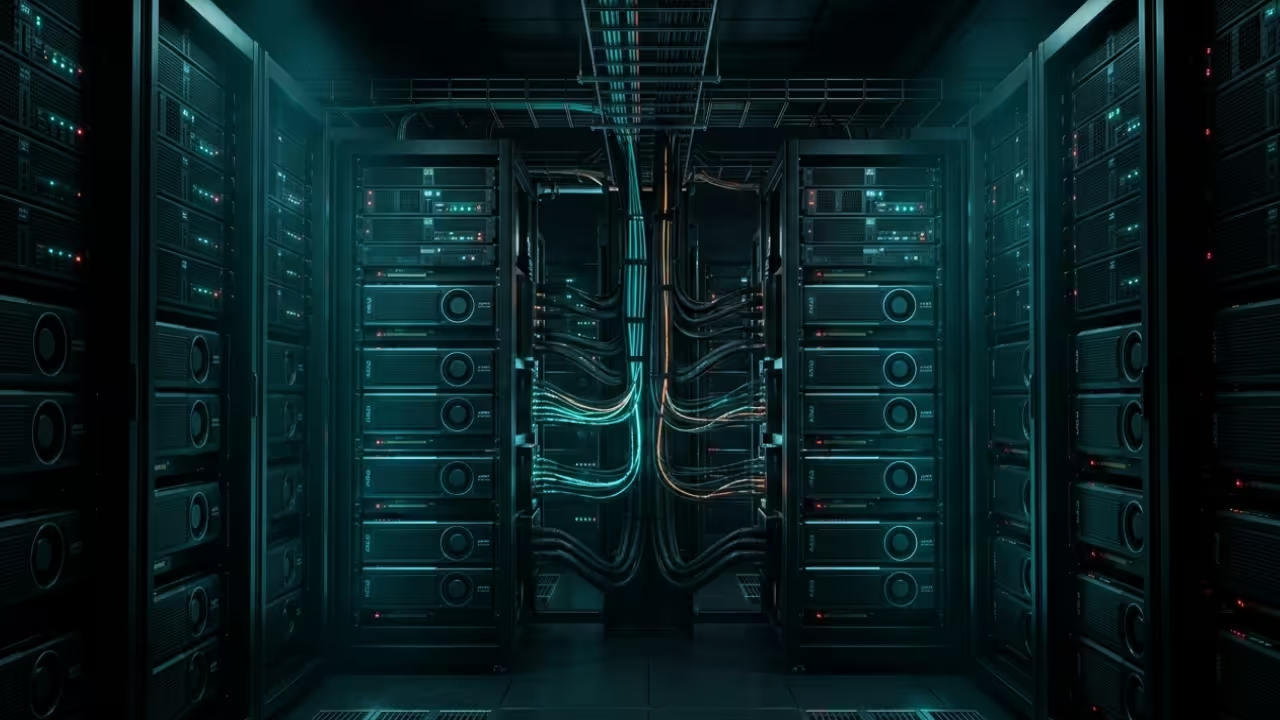
    Professional Server Node in a broadcast rack
    The heart of a modern open source broadcast infrastructure

    Unlocking High Performance Graphics with ROCm

    To truly unlock the potential of this stack on modern AMD hardware you must enable the Vulkan backend for internal compositing. Standard configurations often default to legacy drivers which can cause stuttering on high refresh displays or Wayland environments.

    Navigate to your configuration file and explicitly define the consumer to utilize the ROCm accelerated paths for real time rendering. This specific tweak ensures that your MI60 or similar compute cards handle the heavy lifting without taxing your main processor.

    Real time CasparCG performance demonstration on Fedora 43

    Hardware Optimization Comparison

    Selecting the right hardware for your broadcast server is critical for maintaining a stable twenty four seven operation. Use the comparison below to understand how different tiers of equipment handle the demanding requirements of live video playback.

    Broadcast Hardware Performance Tiers
    Parameter Entry Level Professional Stack Enterprise Grade
    CPU Cores 4 Cores 8 Cores 16 Cores
    GPU Type Integrated Radeon RX Instinct MI60
    RAM Capacity 8GB 32GB 128GB
    Storage Speed SATA SSD NVMe Gen4 NVMe Gen5
    Parameter Entry Level Professional Stack Enterprise Grade
    Hardware requirements for varying production scales
    Internal server components
    High speed hardware textures
    Software interface visualization
    Data flow visualization

    Enterprise Hardware Excellence

    When deploying at scale the reliability of your physical compute cluster becomes the primary bottleneck for your production. Rugged industrial designs paired with high performance cooling allow your MI60 cluster to maintain peak clock speeds under heavy load.

    AMD MI60 cluster within a Server Node
    Industrial hardware cluster optimized for ROCm broadcast delivery

    Master the Professional Stack

    Mastering the professional stack requires more than just software knowledge as it demands a deep understanding of system architecture. You can accelerate your learning curve by accessing high quality resources designed for the modern technical enthusiast and engineer.

    The future of broadcasting belongs to those who control their own infrastructure rather than renting it from others. By leveraging the power of Vulkan and ROCm within CasparCG you ensure your productions remain cutting edge for years.

    Start building your high performance playout system today and leave the world of restrictive proprietary software behind forever. You deserve a workflow that scales with your ambition without draining your bank account every single month.

  • Stop Hand Rigging AI Generated Python Rigging for Complex Characters

    Stop Hand Rigging AI Generated Python Rigging for Complex Characters

    You are currently trapped in a cycle of manual labor that is killing your creative output and scaling potential. Every hour you spend clicking individual vertices for weight painting is an hour stolen from high level architectural innovation.

    Modern production pipelines have evolved past the point where manual character rigging is a viable or profitable skill set. We are witnessing a fundamental shift where algorithmic precision replaces the tedious inaccuracies of the human hand.

    High performance MI60 GPU node cluster for procedural rigging
    The MI60 hardware cluster powers real time algorithmic character rigging.

    The Experience of Algorithmic Mastery

    Imagine the absolute power of watching a complex mechanical beast rig itself in seconds using local hardware acceleration. You feed a raw mesh into your pipeline and witness the local LLM generate perfectly constrained Python logic.

    The friction of technical debt disappears as your MI60 workstation processes rigging parameters through a dedicated ROCm stack. There is a profound sense of professional clarity when your code handles the heavy lifting of vertex groups.

    Live demonstration of AI generated Python scripts in the Blender viewport.

    The transition from a manual artist to a systems architect feels like upgrading from a shovel to an excavator. You no longer fear client revisions because your procedural script adapts to mesh changes with a single execution command.

    This workflow grants you the freedom to focus on the motion aesthetics rather than the underlying skeletal constraints. High performance computing finally meets creative expression in a way that feels both inevitable and revolutionary for your brand.

    Technical Configuration for ROCm and Vulkan

    To maximize performance on the AMD ROCm stack you must prioritize the Vulkan backend when initializing your headless Blender instances. Ensure your environment variables are set to export the HIP_VISIBLE_DEVICES to target your MI60 specifically during the inference.

    This optimization prevents the CPU bottleneck that typically plagues local LLM script generation within complex 3D environments. By bypassing the standard translation layers you achieve a near instantaneous bridge between the LLM output and the viewport.

    Manual Versus Automated Rigging Comparison
    Parameter Manual Rigging AI-Python Rigging
    Setup Time 4 to 8 Hours 30 to 60 Seconds
    Precision Human Error Prone Mathematical Accuracy
    Scalability One Mesh Only Infinite Iterations
    Hardware Load Low GPU Usage High ROCm Utilization
    Export Quality Variable Standardized glTF
    Parameter Manual Rigging AI-Python Rigging
    Performance metrics highlighting the efficiency gains of procedural automation.
    Holographic Python API console showing skeletal data
    Local LLM generated Python scripts directing bone constraints.
    Complex non humanoid mechanical mesh with wireframe
    Automated rigging applied to non humanoid mechanical structures.

    Master the Professional Stack

    Mastering the professional stack requires moving beyond basic tutorials into high impact implementation strategies used by industry leaders. You can find comprehensive guides on these advanced automation techniques by exploring our curated selection of technical resources.

    Whether you are scaling an open source project or building proprietary tools we provide the necessary technical oversight. Schedule a session with our senior architects to ensure your systems are running at peak performance.