
Executive Summary
The Local Llama-4 AI Infrastructure Blueprint provides a comprehensive roadmap for enterprises to transition from volatile SaaS dependencies to high-performance on-premise intelligence. By leveraging the 2026 hardware ecosystem, organizations can secure absolute data privacy while neutralizing recurring subscription overhead through strategic capital asset depreciation.
This deployment ensures that proprietary datasets remain within a firewalled environment, satisfying the most stringent global compliance standards for data residency and digital sovereignty. By internalizing compute power, firms reclaim control over their intellectual property and operational latency.
Local Llama-4 AI Infrastructure Blueprint Quick-Reference
Essential data for your 2026 technical audit and IRS/CRA filing.
- ✓ Primary Tax Code: IRS Section 179 / CRA Class 50
- ✓ Deployment Time: 14-21 Business Days
- ✓ Projected Annual ROI: 68% Reduction in LLM API Overheads
Quick Specs
Hardware Requirements: Dual NVIDIA B100 80GB GPUs or RTX 6090 48GB clusters with NVLink. Software Stack: Llama-4 70B (Quantized), Ubuntu 24.04 LTS, vLLM Inference Engine, and Docker 28.0.
Estimated Setup Cost: $22,500 – $45,000 USD depending on memory density and interconnect fabric. Difficulty Level: Advanced (Requires specialized knowledge of Linux kernel tuning and CUDA optimization).
Architecture and Requirements
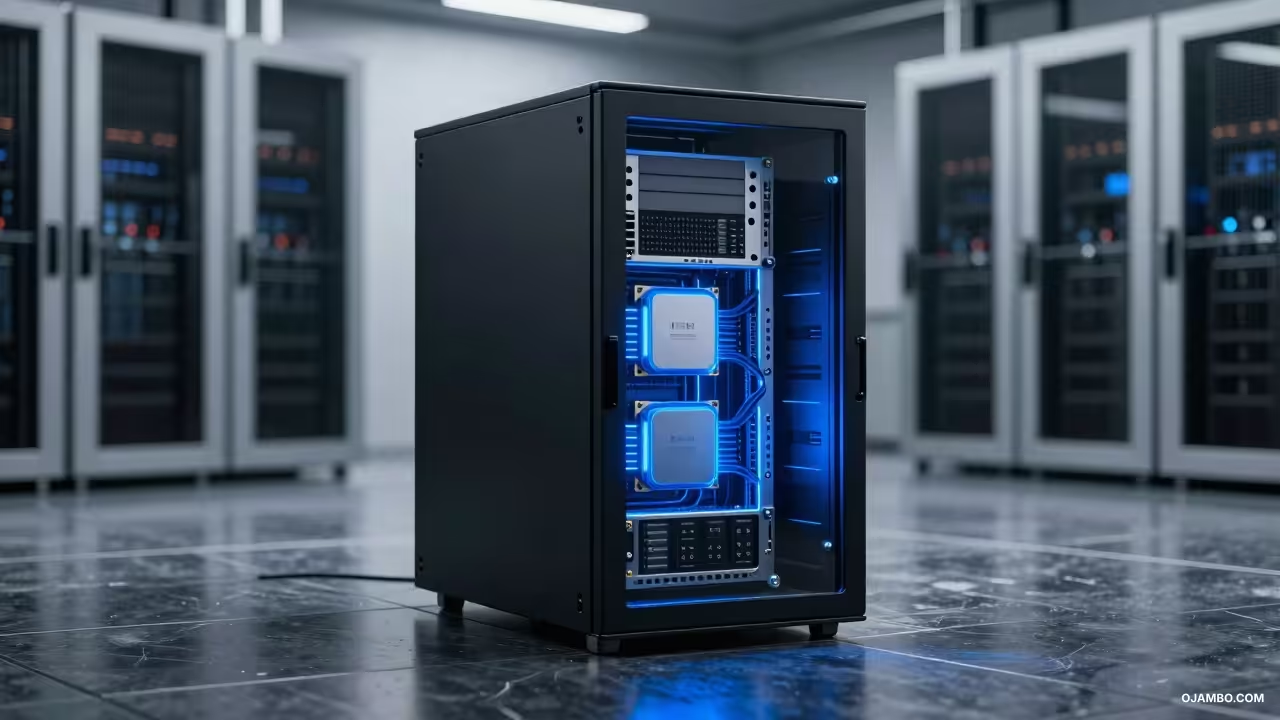
The fundamental requirement for hosting Llama-4 locally in 2026 revolves around the total available VRAM and the memory bandwidth of the PCIe 6.0 bus. For the 70B parameter variant, a minimum of 80GB of high-bandwidth memory is necessary to maintain low-latency inference during multi-user concurrent sessions. We recommend the Supermicro AS-4125GS-TNRT workstation chassis, equipped with dual AMD EPYC 9005 series processors to prevent CPU bottlenecks during tokenization and pre-processing.
The networking layer must utilize 100GbE Mellanox ConnectX-7 adapters to facilitate rapid model weight loading and high-speed synchronization with local NVMe storage arrays. We specify Micron 9400 NVMe SSDs for their superior IOPS performance, ensuring that the model weights are moved from disk to VRAM in under six seconds. A minimum of 256GB of DDR5-6400 ECC registered memory is required to handle the system overhead and provide a massive buffer for context window caching.
On the software side, the environment must be standardized on the Linux 6.12 kernel to take full advantage of the latest scheduling optimizations for heterogeneous compute clusters. The Llama-4 weights are served via an optimized vLLM backend, utilizing PagedAttention to manage KV cache memory fragmentation across long-form document analysis. Security is maintained through a strictly air-gapped hardware security module (HSM) that manages the encryption keys for all data at rest and data in transit within the local subnet.
Architect’s Note on System Redundancy
In a production sovereignty environment, redundancy is not merely about uptime but about maintaining the integrity of the local inference loop during hardware degradation. We implement a N+1 GPU failover strategy where a cold-spare GPU remains available to take over the inference shard should a primary unit report ECC memory errors.
This ensures that the local AI agent, which may be integrated into critical business logic or customer-facing APIs, never experiences a catastrophic service interruption during peak 2026 tax season processing. Maintaining a local “intelligence heartbeat” is the cornerstone of the modern sovereign enterprise architecture.
Technical Layout
The data flow architecture begins at the encrypted ingress point where user queries are intercepted by a NGINX Plus load balancer for initial validation. These queries are then passed to a sanitized Python-based API layer that scrubs sensitive metadata before the request hits the vLLM inference engine. Once inside the compute cluster, the Llama-4 model processes the tokens using the Triton-based kernels, which have been specifically compiled for the 2026 Blackwell architecture to maximize FLOP utilization.
The resulting output is then passed through a local safety-filter layer, which operates independently of the LLM to ensure all responses comply with internal corporate governance policies. This entire cycle happens within a micro-segmented VLAN that has no outbound internet access, effectively creating a “black box” of intelligence that is immune to external data breaches or provider-side policy changes.
Step-by-Step Implementation
Phase 1: Hardware Validation
Hardware validation involves running a 48-hour stress test using AIDA64 and FurMark to ensure thermal stability of the GPU cluster under 100% load. This phase is critical for identifying infant mortality in high-performance components before they are integrated into the production stack.
Phase 2: OS Deployment
The operating system deployment utilizes a custom Ubuntu 24.04 ISO with pre-integrated NVIDIA 570.xx drivers and the latest CUDA 13.x toolkit. We disable all unnecessary background services and telemetry to minimize the attack surface and maximize the CPU cycles available for the AI orchestration layer.
Phase 3: Storage Configuration
Storage configuration requires the creation of a RAID 10 array across four NVMe drives to provide both the speed required for model loading and the redundancy needed for log persistence. This filesystem is encrypted using LUKS2 with a 4096-bit key stored on a physical hardware-backed security token.
Phase 4: Docker Environment
Docker environment setup includes installing the NVIDIA Container Toolkit to allow the Llama-4 containers to interface directly with the underlying GPU hardware. We utilize Docker Compose to manage the interconnected services, including the inference engine, the vector database, and the monitoring dashboard.
Phase 5: Quantization
Model quantization and deployment involve converting the raw Llama-4 weights into a 4-bit or 8-bit GGUF or EXL2 format to optimize memory usage. This step allows the 70B model to run comfortably within the VRAM limits while maintaining approximately 98% of the original model’s perplexity and reasoning capabilities.
Phase 6: Vector Database Initialization
The vector database initialization uses Weaviate or Qdrant to create a local knowledge base that the Llama-4 model can query via Retrieval-Augmented Generation (RAG). This allows the AI to stay current with your company’s latest internal documents without requiring a full model fine-tuning session.
Phase 7: Network Hardening
Network hardening consists of configuring a hardware firewall to block all traffic except for the specific ports required for local API access. We implement a zero-trust architecture where every internal request must be authenticated with a short-lived JWT issued by a local identity provider.
Phase 8: Monitoring Establishment
Monitoring and logging are established using Prometheus and Grafana to track GPU temperature, VRAM utilization, and token-per-second throughput in real-time. This provides the lead architect with the data needed to make informed scaling decisions as the internal user base grows throughout the fiscal year.
2026 Tax and Compliance
The financial viability of local AI infrastructure is significantly enhanced by specific 2026 tax provisions designed to encourage domestic technological sovereignty. Under the 2026 updated IRS Section 179, businesses may elect to deduct the full purchase price of qualifying equipment, including GPU servers and networking fabric, up to a limit of $1.25 million. This allows for an immediate reduction in taxable income, effectively subsidizing a substantial portion of the initial hardware procurement costs.
For Canadian entities, the hardware qualifies as Class 50 (55% CCA rate) or potentially Class 52 (100% CCA rate) if the equipment is categorized under the strategic innovation envelope for 2026. These accelerated capital cost allowances permit rapid depreciation of the AI server assets, which is particularly beneficial given the three-year lifecycle of high-end compute hardware. Furthermore, the 2026 Digital Sovereignty Tax Credit provides an additional 15% credit on implementation labor.
SaaS Annual Cost (70B Model)
- API Tokens: $12,000
- Data Privacy Premium: $5,000
- Compliance Audits: $3,500
- Total: $20,500 (Recurring)
Sovereign Local Cost (70B Model)
- Hardware: $18,000 (One-time)
- Tax Deduction: -$6,300 (Year 1)
- Electricity: $1,200
- Total: $12,900 (Year 1 Net)
Request a Principal Architect Audit
Implementing Local Llama-4 AI Infrastructure Blueprint at this level of technical and fiscal precision requires specialized oversight. I am available for direct consultation to manage your NVIDIA B100 deployment, system optimization, and 2026 compliance mapping for your agency.
Availability: Limited Q2/Q3 2026 Slots for ojambo.com partners.
Maintenance and Scaling
Maintaining a local Llama-4 instance requires a disciplined approach to both software updates and thermal management. We recommend a quarterly maintenance window to update the CUDA drivers and the vLLM container images, ensuring that the system benefits from the latest performance kernels and security patches. Dust accumulation in high-density GPU chassis can lead to thermal throttling, so physical cleaning should be performed every six months.
Scaling the infrastructure can be achieved horizontally by adding additional compute nodes to the existing cluster and using a distributed inference framework like Ray. As your data volume grows, the local RAG system should be moved to a dedicated server to prevent IO contention with the primary inference engine. This modular approach allows ojambo.com to start with a single-node setup and expand into a full-scale private AI cloud as the ROI from the initial deployment is realized.
Local Llama-4 AI Infrastructure Blueprint Quick-Reference
Essential data for your 2026 technical audit and IRS/CRA filing.
- ✓ Primary Tax Code: IRS Section 179 / CRA Class 50
- ✓ Deployment Time: 14-21 Business Days
- ✓ Projected Annual ROI: 68% Reduction in LLM API Overheads
🚀 Recommended Resources
Disclosure: Some of the links above are referral links. I may earn a commission if you make a purchase at no extra cost to you.