
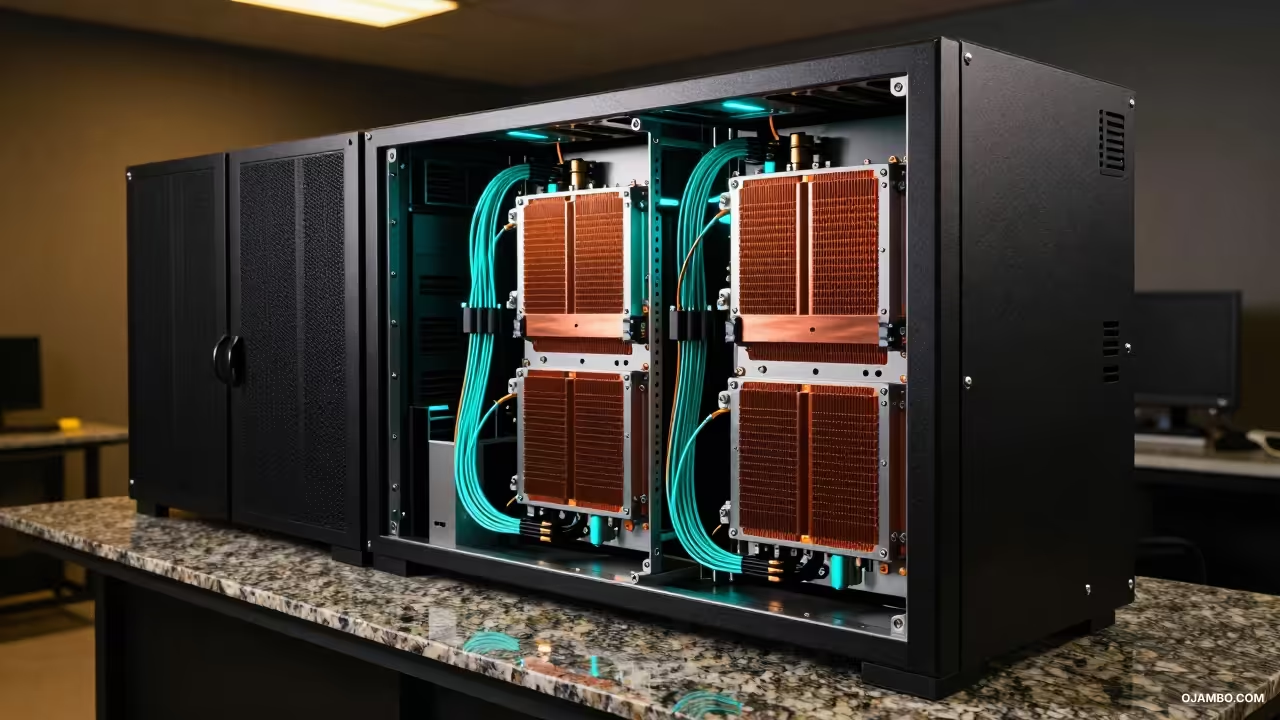
The 2026 CRA Class 50 Accelerated AI Audit project provides a rigorous technical and financial framework for Canadian and international enterprises to modernize their local compute infrastructure. By leveraging specific Capital Cost Allowance provisions, organizations can offset the high initial expenditure of AI-capable hardware against their gross professional income. This guide serves as the definitive architecture for deploying high-performance local inference engines while maintaining strict adherence to current federal tax audit requirements.
The primary financial objective is the immediate reduction of taxable income through the accelerated depreciation of computer equipment and integrated systems software. From a technical perspective, this deployment transitions a firm from expensive, recurring SaaS subscriptions to a self-hosted, high-availability environment that preserves data sovereignty. This dual-purpose strategy ensures that every dollar spent on silicon is maximized for both computational throughput and year-end fiscal reporting.
2026 CRA Class 50 Accelerated AI Audit Quick-Reference Blueprint
Essential data for your 2026 technical audit and CRA filing.
- ✓ Primary Tax Code: CRA Class 50 (55% CCA) / IRS Section 179
- ✓ Deployment Time: 14-21 Business Days
- ✓ Projected Annual ROI: $12,000 – $45,000 in SaaS Displacement
Quick Specs
Hardware Requirements: NVIDIA Blackwell B200 or RTX 6000 Ada Generation, 256GB DDR5 ECC RAM, Dual 2000W Platinum PSU. Software Stack: Ubuntu 24.04.2 LTS, NVIDIA CUDA 13.1, Docker Engine 28.0, vLLM Inference Engine v0.7.2. Estimated Setup Cost: $18,500 – $45,000 USD (Varies by GPU density and high-speed networking requirements). Difficulty Level: Advanced (Requires expertise in Linux systems administration, LLM quantization, and tax accounting).
Architecture and Requirements
The foundational hardware for a 2026-compliant AI workstation must satisfy the CRA definition of “general-purpose electronic data processing equipment.” We recommend the AMD EPYC 9004 series platform, specifically the 9654P with 96 cores, to ensure there are no bottlenecks during heavy RAG (Retrieval-Augmented Generation) indexing. For memory, 512GB of DDR5-6000 MT/s ECC Registered RAM is the baseline for handling multi-billion parameter models in a multi-tenant environment. This configuration allows for the simultaneous execution of localized inference and background data processing without memory-related system crashes.
Storage must be bifurcated between high-speed NVMe and redundant bulk storage to satisfy both performance and audit-trail requirements. The primary drive should be a 4TB PCIe Gen 5.0 x4 NVMe SSD, capable of 14,000 MB/s sequential reads, to facilitate rapid model loading into VRAM. For data persistence and backup, a RAID 6 array of 22TB enterprise SAS drives provides the necessary redundancy for historical audit logs. Network connectivity requires a minimum of Dual 10GbE SFP+ ports to integrate with existing local area networks while providing overhead for future fiber-optic upgrades.
On the software side, the kernel must be hardened against external threats to protect the intellectual property generated by the AI models. We utilize the 2026 Long Term Support (LTS) version of Ubuntu, coupled with the latest stable NVIDIA drivers to ensure compatibility with Blackwell-class architecture. The inference layer is managed via vLLM or TGI (Text Generation Inference), which optimizes VRAM usage through PagedAttention algorithms. This technical stack ensures that the hardware remains at peak efficiency, justifying the accelerated depreciation claims made during the 2026 tax season.
Architect’s Note on Data Sovereignty
A critical component of the 2026 CRA Class 50 audit is proving the equipment is used primarily for business operations. By hosting models like Llama 3.5 or Mistral Large 3 locally, you eliminate the “Data Residency” risks associated with third-party cloud providers. This architectural choice serves as a primary defense during a manual CRA review, as it demonstrates a clear business necessity for high-performance, private local hardware over public API alternatives.
Technical Layout
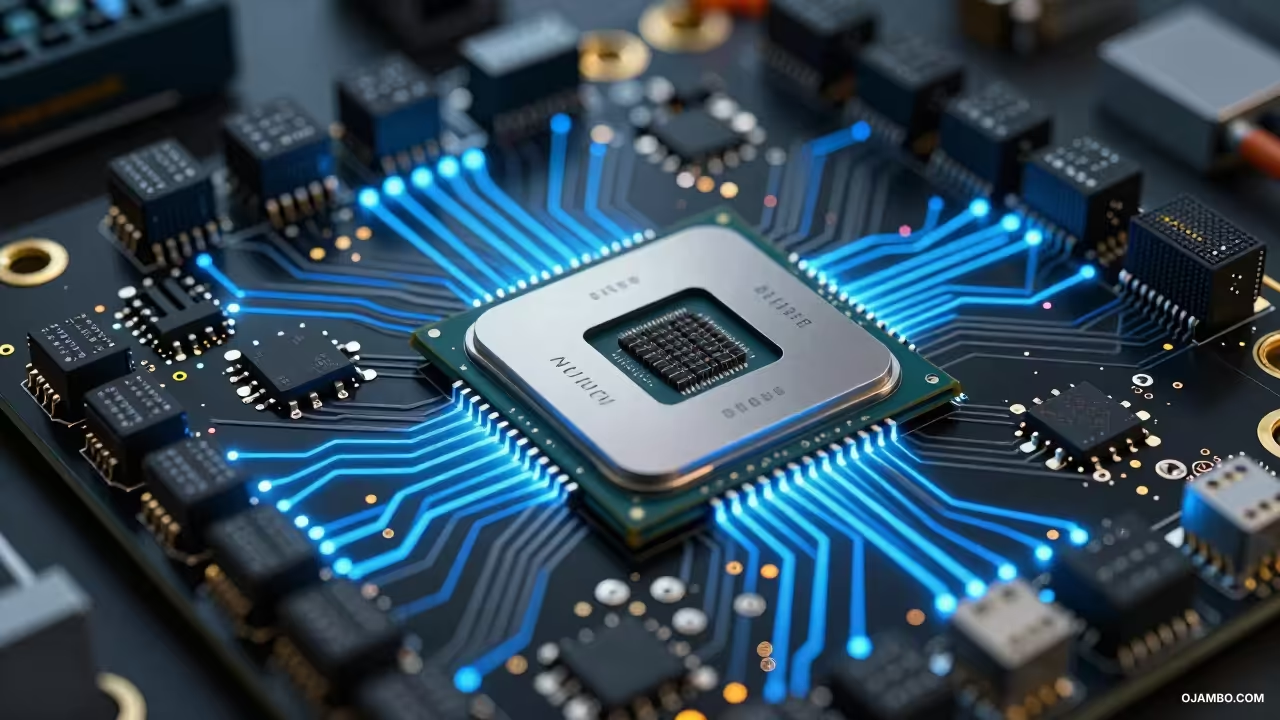
The technical data flow within the 2026 CRA Class 50 Accelerated AI Audit framework is designed for maximum throughput and security. Raw data enters the system through an encrypted TLS 1.3 gateway, where it is immediately pre-processed by a dedicated CPU-bound microservice. Once cleaned, the data is pushed to the GPU VRAM for inference using 4-bit or 8-bit quantization methods, which balances speed with mathematical precision. The resulting output is then cached in a Redis-on-Flash database and logged to an immutable audit file for compliance purposes. This architecture prevents data leakage by ensuring that no proprietary information ever leaves the local network boundary during the inference cycle. The separation of the management plane from the data plane further hardens the system against unauthorized access or lateral movement within the network.
Step-by-Step Implementation
Phase 1: Physical Environment Preparation
Before hardware arrival, ensure the facility supports the thermal output of a high-density AI server. This requires a dedicated 20-amp circuit with a NEMA 5-20R outlet to prevent power delivery failures under full computational load. Install a 30,000 BTU split-unit air conditioner to maintain an ambient temperature of 20 degrees Celsius, preventing thermal throttling of the B200 or RTX 6000 components.
Phase 2: Hardware Assembly and Stress Testing
Assemble the components on an anti-static surface, ensuring all PCIe 5.0 lanes are correctly seated and the dual PSUs are configured for failover mode. Run a 48-hour burn-in test using MemTest86+ for the RAM and FurMark for the GPUs to identify any “infant mortality” issues in the silicon. Document these tests with timestamps and serial numbers to create a technical paper trail for the CRA Class 50 asset verification.
Phase 3: OS Installation and Kernel Hardening
Install Ubuntu 24.04 LTS using a ZFS file system to enable instantaneous snapshots and data integrity checking at the block level. Disable all non-essential services and ports, keeping only SSH (protected by RSA-4096 keys) and the specific ports required for the AI API. Apply the latest microcode updates for the AMD EPYC or Intel Xeon CPU to mitigate hardware-level vulnerabilities discovered in early 2026.
Phase 4: Driver and CUDA Toolkit Deployment
Install the NVIDIA 555+ series production drivers and the CUDA 13.1 toolkit to unlock the full potential of the Blackwell architecture. Configure the NVIDIA Persistence Daemon to ensure the GPUs remain initialized and ready for immediate inference tasks, reducing latency for the end-user. Verify the installation using the nvidia-smi command, logging the output as proof of functional operation for the tax year.
Phase 5: Containerized Inference Setup
Deploy Docker Engine along with the NVIDIA Container Toolkit to isolate the AI models from the host operating system. Pull the official vLLM or Ollama images and configure them to utilize the specific GPU UUIDs identified in the previous phase. This containerized approach allows for rapid scaling and simplifies the process of updating model weights without disturbing the underlying system configuration.
Phase 6: Vector Database and RAG Integration
Set up a Pinecone-local or Milvus instance to handle the high-dimensional vector embeddings required for Retrieval-Augmented Generation. This allows the AI to access your company’s private 2026 documents and audit logs in real-time without retraining the base model. Ensure the vector database is synchronized with the primary NVMe storage to prevent data loss during power fluctuations or system reboots.
Phase 7: API Gateway and Load Balancing
Implement an NGINX or Traefik reverse proxy to manage incoming requests to the AI inference engine. Configure rate limiting and API key authentication to ensure that only authorized internal users can access the computational resources. This layer provides the necessary telemetry to prove to the CRA that the system is being used exclusively for revenue-generating business activities.
Phase 8: Security Hardening and Monitoring
Install Prometheus and Grafana to monitor the system’s power consumption, temperature, and compute utilization in real-time. Set up automated alerts for any unauthorized access attempts or hardware failures that could impact the 2026 tax-deductible status of the asset. Finally, perform a penetration test to confirm that the internal firewall (ufw or nftables) is correctly blocking all non-essential traffic.
2026 Tax and Compliance
The primary incentive for this project is the Canadian Income Tax Act’s Capital Cost Allowance (CCA) Class 50. Under this class, computer hardware and integrated systems software acquired after 2007 can be depreciated at a rate of 55% per year on a declining balance basis. For the 2026 tax year, the “Accelerated Investment Incentive” may still provide a first-year increase to the claimable amount, allowing businesses to recover a significant portion of their AI investment almost immediately.
In the United States, IRS Section 179 allows for the immediate expensing of up to $1,220,000 (inflation-adjusted for 2026) of qualifying equipment. This includes “off-the-shelf” software and high-performance servers used for business operations more than 50% of the time. Additionally, the Bonus Depreciation rules for 2026, though potentially phased down, still offer a powerful mechanism for deducting a large percentage of the purchase price in the year of acquisition.
Beyond simple depreciation, the development of custom AI workflows and localized model fine-tuning may qualify for the Scientific Research and Experimental Development (SR&ED) tax credit in Canada. This requires detailed technical logs showing that the organization faced “technical uncertainty” and followed a “systematic investigation” to resolve it. Our architecture’s extensive logging and monitoring setup directly support the documentation requirements needed to pass a manual SR&ED or CRA audit.
SaaS Model (Recurring)
First-Year Deduction: 100% of Subscription
Long-Term ROI: Negative (Ongoing Cost)
Data Sovereignty: Low (Cloud Risk)
Self-Hosted AI (Class 50)
First-Year Deduction: 55% to 100% (Class 50/Sec 179)
Long-Term ROI: Positive (Asset Ownership)
Data Sovereignty: Absolute (Local)
Request a Principal Architect Audit
Implementing 2026 CRA Class 50 Accelerated AI Audit at this level of technical and fiscal precision requires specialized oversight. I am available for direct consultation to manage your NVIDIA Blackwell B200 deployment, system optimization, and 2026 compliance mapping for your agency.
Availability: Limited Q2/Q3 2026 Slots for ojambo.com partners.
Maintenance and Scaling
Maintaining a high-performance AI node requires a proactive approach to both hardware and software updates. We recommend a quarterly schedule for cleaning the internal chassis of dust and verifying the integrity of the liquid cooling loops if utilized. Firmware updates for the motherboard and GPU should be vetted in a staging environment before deployment to the primary production node to avoid unexpected downtime.
Scaling the infrastructure can be achieved through the addition of secondary “compute nodes” linked via InfiniBand or 100GbE networking. As the 2027 tax year approaches, these additional nodes can be treated as separate Class 50 acquisitions, further extending the tax-advantaged window for the organization. By maintaining a modular architecture, ojambo.com ensures that it can pivot to newer silicon—such as future Rubin-class GPUs—without needing to overhaul the entire network and compliance framework.
Regular backup protocols must include off-site, encrypted copies of the model weights, vector databases, and system configurations. Utilizing a 3-2-1 backup strategy (three copies, two different media, one off-site) ensures business continuity even in the event of a catastrophic local failure. This level of professional redundancy not only protects the technical investment but also demonstrates to auditors that the system is a vital, well-managed component of the corporate enterprise.
2026 CRA Class 50 Accelerated AI Audit Quick-Reference Blueprint
Essential data for your 2026 technical audit and CRA filing.
- ✓ Primary Tax Code: CRA Class 50 (55% CCA) / IRS Section 179
- ✓ Deployment Time: 14-21 Business Days
- ✓ Projected Annual ROI: $12,000 – $45,000 in SaaS Displacement
🚀 Recommended Resources
Disclosure: Some of the links above are referral links. I may earn a commission if you make a purchase at no extra cost to you.